Wednesday, October 07, 2009

A new practical guide to human rights education

A new practical tool to promote human rights education is now available. The new tool, which collects 101 exemplary practices from Central Asia, Europe and North America, is a valuable resource for teachers and education policymakers.
Among the good practices featured in the collection is “Build Bridges, Not Walls”, a Norwegian publication with 97 exercises on human rights, multicultural understanding and peaceful conflict resolution. The exercises, designed for non-formal learning settings such as those involving refugees and immigrants, are already in use in Norway, South-Eastern Europe and Eastern Europe, including conflict areas.
Human rights education is vital for all our societies. “It promotes equality, empowerment and participation as well as conflict prevention and resolution. In brief, it is a means to develop societies where the human rights of all are respected, protected and fulfilled,” said the heads of the four partner organizations in their joint foreword to the collection.
The collection, entitled “Human Rights Education in the School Systems of Europe, Central Asia and North America: A Compendium of Good Practice” , is a joint publication by the
Office of the High Commissioner for Human Rights (OHCHR), the Office for Democratic Institutions and Human Rights of the Organization for Security and Co-operation in Europe (OSCE/ODIHR), the Council of Europe (CoE), and the United Nations Educational, Scientific and Cultural Organization (UNESCO).
Designed for primary and secondary schools, teacher training institutions and other learning settings, the this tool collects good practices of human rights education, education for democratic citizenship, and education for mutual respect and understanding.
It provides resource materials relevant to key elements for successful human rights education, including 1) laws, guidelines and standards; 2) learning environment; 3) teaching and learning tools; 4) professional development for educators, and 5) evaluation.
The collection demonstrates creative approaches to human rights education and aims to facilitate networking and exchange of experience among education professionals. The practices can be adapted to local conditions anywhere in the world.
Launched on 2 October in Warsaw, Poland, the collection contributes to the national implementation of the
World Programme for Human Rights Education, a global initiative of the UN General Assembly .
2 October 2009
Fonte,http://www.ohchr.org/EN/NewsEvents/Pages/HRsEducationBook.aspx, consultado a 7 de Outubro de 2009.

Thursday, August 27, 2009

Tribute paid to humanitarian workers

25 August 2009 / 10:32
[Dateline: New York Authors: iSeek]

UN staff around the world observed the first-ever
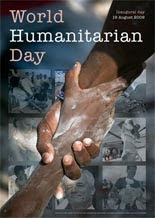
World Humanitarian Day on Wednesday, 19 August, paying tribute to the colleagues lost in the line of duty, as well as those who undertake humanitarian work for the United Nations and its partners in many difficult places around the world.The day’s events were spearheaded by the Office for the Coordination of Humanitarian Affairs (OCHA).
Established last December by the General Assembly (
A/RES/63/139 ) , the date was chosen to mark the date of the 2003 bombing of the Canal Hotel in Baghdad which killed 22 staff members, including the top United Nations envoy in Iraq, Sergio Vieira de Mello, and wounded more than 150.
Organizers of World Humanitarian Day hope the annual celebration will increase public understanding of humanitarian assistance world wide as well as honoring humanitarian workers who have lost their lives or been injured in the course of their work.
SG message for the day
New York
The Secretary-General attended two related events on Wednesday morning – a somber wreath-laying ceremony to honor those killed in Baghdad six years ago and the launch of
an exhibition of posters and photographs capturing images of humanitarian workers in action.In his remarks, the SG said “Each year on August 19th, we will honour the memory of fallen humanitarians. We will pay tribute to the dedicated men and women who are out there among the vulnerable, providing hope and help. And we will draw the world's attention to the great magnitude of suffering in our world that needs our urgent attention.”
He added, “For my part, I pledge to do all that I can as Secretary-General of the United Nations to help victims while protecting the security and independence of the people who work so hard to save them”(
full remarks ). Joining Mr. Ban at the Headquarters ceremony was Assistant Secretary-General for Humanitarian Affairs Catherine Bragg who noted that aid workers are working in ever more dangerous conditions.
“The last two years have been successively the most deadly for aid workers on record,” she stated. “Too often, UN and NGO flags and emblems are no longer protections but provocations.”
Geneva
Considered by many to be the humanitarian capital of the world, an inter-agency event took place in Geneva’s Parc des Bastions which included participation from Swiss and Geneva authorities as well as the various agencies working in the humanitarian field.
In his remarks, Director-General Sergei A. Ordzhonikidze highlighted the sad figures from last year stating that “a record of 260 humanitarian aid workers from different agencies and charities were victims of kidnappings and attacks, including 122 who were killed.”
Also speaking was Mrs. Annie Vieira de Mello, widow of Sergio Vieira de Mello, who spoke about the
foundation which has been set up in her late husband’s memory.
The event also included wide range of music from different parts of the world and some fine culinary tastes from Senegal and, of course, Brazil.
Other events
A number of events were held in various UN offices around the world including Chad, Democratic Republic of Congo, Dubai, Ethiopia, Fiji, Indonesia, Iraq, Kenya, Myanmar, Nepal, New Zealand, the occupied Palestinian territories, Somalia, Sri Lanka, Thailand and Zimbabwe.
Staff from the UN Information Centres in Beirut and Warsaw were particularly instrumental in getting the word out about the day in Arabic, French and Polish by participating in several radio interviews and generating a high-level of traditional and online media coverage.
The following is a short overview of some of these events.
Democratic Republic of the Congo
In the Democratic Republic of the Congo a two-hour event was organized with some 200 guests from the press, the government, humanitarian partners, donors and NGOs, followed by live broadcasting in collaboration with
Radio Okapi , the UN peacekeeping mission’s radio.
Kenya
Activities organized by OCHA in Kenya focused on “the Human Face of Drought” and included an
IRIN (Integrated Regional Information Networks) photo essay on drought and the dissemination of posters on this theme.
Nepal
OCHA’s ceremony in Nepal featured screenings of films on humanitarian action in the country, a musical interlude and personal tributes to humanitarian workers by colleagues, in the presence of government officials.
Pakistan
In Pakistan, the UN Information Centre in Islamabad held discussion forum with the heads of national and international print and electronic media in advance of the day on 6 August with Humanitarian Coordinator Wolfgang Herbinge and communication specialists from OCHA, the World Food Programme and UNICEF which resulted in a high-level of interest from the media in the country.
Also appreciated was the UNIC’s translation of material into one of the local languages, Urdu.
Awards for best print and broadcast media on the humanitarian crisis in Pakistan were announced. The honorary award will be given out on UN Day in October.
Sudan
OCHA’s office in Sudan launched a joint UN/NGO online photo exhibition depicting humanitarian, early recovery, recovery and development work while local TV stations also broadcasts a public service announcement.
Tanzania
The UN System in Tanzania’s observance was coordinated by UNIC Dar es Salaam and held at the UN compound under the leadership of Acting UN Resident Coordinator, Mr Ronald
Sibanda.
During the event, UN flag was hoisted followed by a minute of silence observed by government representatives, members of the media and staff in attendance.

Link,
http://www.un.int/wcm/content/site/portal/cache/offonce/home/pid/10617;jsessionid=13149E379C11D6D24FBC37B1DEB26FC4
, consultado a 26 de Agosto de 2009

Wednesday, August 26, 2009

Mensagem do Secretário-Geral das Nações Unidas, Ban Ki-moon, por ocasião do Dia Mundial da Ação Humanitária, 19 de Agosto de 2009

Hoje é o primeiro Dia Mundial da Ação Humanitária, proclamado pela Assembléia Geral das Nações Unidas.
Ele representa, acima de tudo, o dia no qual renovamos nosso compromisso em ajudar pessoas vulneráveis e marginalizadas onde quer que elas estejam. Essa é a principal missão da comunidade humanitária.
Esse também é o dia no qual prestamos homenagens às legiões de heróicos trabalhadores humanitários. Esses homens e mulheres têm diferentes origens, mas compartilham a mesma convicção: o sofrimento de uma pessoa é responsabilidade de todos.
A data dessa homenagem anual lembra o dia do ataque à sede das Nações Unidas em Bagdá, que matou 22 pessoas dedicadas ao trabalho, incluindo o grande humanitário Sérgio Vieira de Mello.
“Continuamos inspirados pelo legado que eles deixaram e permanecemos determinados a levá-lo adiante. A
Fundação Sérgio Vieira de Mello está fazendo o mesmo ao organizar o prêmio anual que leva o nome do brasileiro, com o objetivo de reconhecer notáveis conquistas na área de resolução pacífica de conflitos.”
Como Sérgio e outros bravos colegas que perderam suas vidas nesse terrível dia, equipes humanitárias se dirigem a regiões de risco para ajudar os outros. Para essas pessoas, não existe conflito esquecido.
Mas para realizar esse nobre trabalho – enfrentando ameaças em meio a desastres e guerras – eles precisam da nossa ajuda. Essas pessoas precisam que trabalhemos sem descanso por sua segurança e independência.
O Dia Mundial da Ação Humanitária foi criado para ampliar o foco sobre as pessoas em risco, para garantir que elas recebam a assistência que merecem. Espero que possamos redobrar nossos esforços para alcançar essa meta. E que cumpramos nosso dever humanitário.
Link,http://www.brasilia.unesco.org/noticias/opiniao/artigooutros/mensagem-do-secretario-geral-das-nacoes-unidas-ban-ki-moon-por-ocasiao-do-dia-mundialda-acao-humanitaria-19-de-agosto-de-2009, consultado a 26 de Agosto de 2009.

WORLD HUMANITARIAN DAY


UN SECRETARY-GENERAL'S MESSAGE


video

"I pledge to do all that I can as Secretary-General of United Nations to help victims while protecting the security and independence of those who work so hard to save them". Secretary-General Ban Ki-moon’s remarks on first World Humanitarian Day, 19 August 2009


Annie Vieira De Mello, Vice Chairwoman of the Sergio Vieira de Mello Foundation, addresses a commemorative event on the first World Humanitarian Day


Annie Vieira de Mello, widow of Sergio Vieira de Mello and Vice Chairwoman of the Sergio Vieira de Mello Foundation, addresses a commemorative event on the first World Humanitarian Day. Location: Geneva, Switzerland Date: 19 August 2009. UN Photo/Jean-Marc Ferre
Link,
http://www.unmultimedia.org/photo/detail/406/0406892.html, consultado a 26 de Agosto de 2009

Annie Vieira de Mello pede protecção para os trabalhadores humanitários
A jornalista Andreia Brito falou ao telefone com Annie Vieira de Mello
(...) Na véspera do Dia Mundial Humanitário, a jornalista Andreia Brito falou ao telefone com a mulher de Sergio Vieira de Mello, Annie Vieira de Mello, que pede às populações e aos Governos para que actuem para proteger os voluntários.
2009-08-18 17:48:05
Link,
http://tv1.rtp.pt/noticias/?headline=46&visual=9&tm=7&t=Mulher-de-Sergio-Vieira-de-Mello-pede-proteccao-para-os-trabalhadores-humanitarios.rtp&article=272093, consultado a 26 de Agosto de 2009.


High Commissioner for Refugees Addresses World Humanitarian


António Guterres, United Nations High Commissioner for Refugees, addresses a commemorative event on the first World Humanitarian Day. Location: Geneva, Switzerland Date: 19 August 2009. UN Photo/Jean-Marc Ferre.
Link,
http://www.unmultimedia.org/photo/detail/406/0406893.html , consultado a 26 de Agosto de 2009

Unsung Heroes of the Battlefields

By Laurent Vieira de Mello, president of the Sergio Vieira de Mello Foundation.
The Washington Post
Wednesday, August 19, 2009


Six years ago today, my father, Sergio Vieira de Mello, was killed in a tragic attack in Baghdad that changed the face of the humanitarian world. A truck filled with bombs exploded in the United Nations compound, killing 22 humanitarian workers and wounding many more. Some who were not physically hurt were psychologically wounded. Even years later, many remain vulnerable.

My father headed the U.N. team in Baghdad. A few days before he was killed, he wrote: "The situation is indeed difficult. But we will succeed, because we will do it with the Iraqi people."

His dedication to serving people in need is shared by thousands of humanitarian workers around the world who sacrifice their time, their energy and, too often, their lives to help those in need in places where wars kill and maim and throw innocent victims into refugee camps or exile. Darfur, Chad, the Democratic Republic of the Congo and Uganda are just a few of these areas.

In recognition of their commitment, my family sought to have Aug. 19 -- the date my father and his fellow workers died while helping destitute people -- designated as World Humanitarian Day. After discussions with our foundation, Brazil, France, Japan, Sweden and Switzerland sponsored a U.N. resolution that was adopted by the General Assembly on Dec. 11, 2008. So for the first time, today is officially an occasion to reflect on the situation for humanitarians deployed in the field.

Sadly, already poor conditions for humanitarian workers in many places are deteriorating. Since 2006, attacks on aid workers have increased sharply, the Overseas Development Institute reports. The Darfur region in Sudan, Afghanistan and Somalia are the most dangerous places, accounting for more than 60 percent of violence against aid workers.

Last year was the worst in 12 years, with 260 humanitarian aid workers killed, kidnapped or seriously injured in violent attacks, according to the institute. This toll exceeds the number of victims among U.N. peacekeeping troops.

The Baghdad bomb attack that killed my father dramatically underscored a fact that humanitarian workers had dealt with since the early 1990s: The U.N. flag had ceased to be bulletproof. It no longer protected U.N. humanitarian workers as well as the staffs of nongovernmental organizations.

Before the 1990s, most wars in the developed world were proxy wars. There was a kind of tacit gentleman's agreement whereby superpowers respected as much as possible the rights and the work of humanitarian personnel.

Now, this did not prevent the deaths of many humanitarians. But most casualties were those who happened to be at the wrong place at the wrong time, caught in the crossfire. Rarely were aid workers targeted.

The situation, though, has changed dramatically. With the rise of nationalism since the fall of communism and the end of the proxy wars, humanitarian workers no longer benefit from protection, flimsy as it may have been before. Victims nowadays are often targeted.

We're talking about the people who are serving on the front line for those of us who weep when we see children on TV crying beside mothers who have been killed by mortar fire -- and believe that something must be done to help these victims and others like them.

Humanitarian workers are the unsung heroes of our time. They are not recognized as such. Yet consider their efforts, seeking to persuade warlords to let them help innocent civilians who are facing heat, cold, disease and other threats.

They never have the money and staff to fully respond to demands. They get up every morning knowing the enormousness of the task ahead of them, carrying on despite the gnawing feeling that whatever they attempt will always be a drop in the ocean. They can help, their efforts can and do save lives, but these workers are aware that their actions amount to little more than a Band-Aid on some of the world's worst problems.

The reality of their tasks would make any of us despair. Not them.

As a humanitarian worker once told me: "We have no right to despair when we see that people who have lost everything, even their family, still have hope."

It is high time for the international community to face its responsibilities and stop hiding behind humanitarian action. The world must stop using humanitarian efforts as a fig leaf. It can no longer avoid action while putting its conscience at rest by sending humanitarian actors into the killing fields. There are lives at risk.

And on this day, because of their courage, dedication, generosity and humility, humanitarian workers deserve our respect. We should not only praise their work but also remind the world that we must protect them, that we must impress on warlords that if they have any humanity left, they should protect and assist these workers. We must remind the world that humanitarian workers are neutral and help those in need, whatever their color, race, religion or political beliefs. They deserve our efforts and our thanks.

Link,http://www.washingtonpost.com/wp-dyn/content/article/2009/08/18/AR2009081802908.html?nav=rss_opinion/columns&sid=ST2009081802974, consultado a 26 de Agosto de 2009

Friday, December 19, 2008

International Migrants Day, 18 December

Press release
18 December 2008


The 9th
International Migrants Day coincides with the 60th anniversary of the adoption of the Universal Declaration of Human Rights (UDHR). Many UDHR provisions vividly relate to some of the threats – racism, xenophobia, labour and sexual exploitation, arbitrary detention and other injustices- and hopes – freedom of movement, right to work, to education, to live in dignity - experienced by millions of women, men and children and demonstrate that migrants rights are human rights. This year also marks the 5th year of the entry into force of the International Convention on the Protection of the Rights of All Migrant Workers and Members of their Families. The decades-long gap in the adoption of a treaty and other human rights tools for the protection of migrant workers is about to have particularly dire consequences. For scores of migrants, the world financial crisis will expose their existing vulnerability to stronger hardship and exploitation. It will also result in diminished remittances to those left behind in their home countries. Ironically, while migrants have often been the invisible architects of many striving economies and least benefited from financial investment and related wealth generating products, they will be amongst the worst hit. It is thus essential that civil society actively monitors respect for the Convention, engages with the UN Committee on Migrant Workers and renews the call for universal ratification. But, the fact that major countries of destination did not ratify this convention does not mean that they should not / and cannot be held accountable. Other international instruments do apply to migrant workers and it is up to migrants’ organisations, civil society and the international community to make use of them. (See December 18’s newest publication, “the Samizdat”.) More than ever, International Migration Day (IMD) is an occasion for international solidarity and for making migrants voices heard. December 18 gives a platform to these testimonies via Radio 1812, a global event that brings together a wide range of radio stations that broadcast special programmes on the occasion of IMD. This unique radio marathon enables migrants’ voices to be heard, not only on community-based radio stations but also on large public broadcasts and via our dedicated website. More than 100 radio stations from over 35 countries will participate in this year’s event. December 18 believes that it is wrong to deal with migration as a security issue only. Many governments want to stay out of the limelight and orchestrate policy discussions, for instance within the Global Forum on Migration and Development conveyed outside of the United Nations thereby excluding civil society from the process. Civil society, including NGOs and migrant organisations often are the sole actors delivering assistance and advice to migrants in countries of origin, transit and arrival. Their unique experience would greatly enrich analyses and solutions oriented discussions respectful of a human rights framework. However, the UDHR and other human rights norms and standards evolved since then and have slowly been integrated in some international, regional and national government responses to migration, including, albeit timidly, in some migration management initiatives. More than ever, civil society, migrant and human rights organisations will need to remind governments of their commitments and highlight the relevance of the Preamble of the UDHR which declares that: “[…] recognition of the inherent dignity and of the equal and inalienable rights of all members of the human family is the foundation of freedom, justice and peace in the world, […] disregard and contempt for human rights have resulted in barbarous acts which have outraged the conscience of mankind, and the advent of a world in which human beings shall enjoy freedom of speech and belief and freedom from fear and want has been proclaimed as the highest aspiration of the common people, […] it is essential, if man is not to be compelled to have recourse, as a last resort, to rebellion against tyranny and oppression, that human rights should be protected by the rule of law, […] it is essential to promote the development of friendly relations between nations.” December continues to work for the respect of the human dignity and the fundamental human rights of all migrant workers and their families.-->
Learn more about
International Migrants Day.

Link,http://www.hrea.org/index.php?base_id=2&language_id=1&headline_id=8409, consultado a 18 de Dezembro de 2008.

Tuesday, December 16, 2008

World Humanitarian Day : 19th August

"We should never forget all the victims, not only in Baghdad and Algiers, who have given their lives for the United Nations," Annie Vieira de Mello, Aug 19, 2008, Reuters.

The General Assembly designates 19th August as World Humanitarian Day / Sergio Vieira de Mello Foundation

General AssemblyGA/10798 / 11 December 2008


OCHA News Centre

12 December 2008

The
General Assembly decided today to designate 19 August as World Humanitarian Day. The
resolution adopted by consensus and sponsored by Sweden reaffirms the United Nations’ unique role in humanitarian emergencies. It calls for increased public awareness about humanitarian assistance activities worldwide and the importance of international cooperation in this regard. It also pays tribute to all humanitarian and United Nations and associated personnel who have worked in the promotion of the humanitarian cause and those who have lost their lives in the cause of duty.
Adopting another
resolution by consensus, the General Assembly expressed deep concern that, over the past decade, threats and attacks against the safety and security of humanitarian personnel and United Nations and associated personnel have escalated dramatically and that perpetrators of acts of violence seemingly operate with impunity. In the resolution sponsored by France on behalf of the European Union, the General Assembly also emphasized the need to pay particular attention to the safety and security of locally recruited humanitarian personnel, who are particularly vulnerable to attacks and who account for the majority of casualties and cases of harassment.
Read the
General Assembly coverage

Link,
http://ochaonline.un.org/News/tabid/1080/Default.aspx, consultado a 15 de Dezembro de 2008.

Saturday, December 13, 2008

The People’s Movement for Human Rights Educación (PDHRE) | Movimiento de los Pueblos para la Educación en Derechos Humanos

español
in English

A Brief Introduction To Our Thinking
More than any other moral language available at this time in history, the language of human rights is able to expose "the immorality and ...barbarism of the modern face of power... We cannot take rights seriously without taking suffering seriously..." (-
Upendra Baxi, Human Rights and Inhuman Wrongs) Poverty, warfare, environmental degradation, the deleterious effects of globalization, discrimination, disease, illiteracy, and labor exploitation are just some of the threats bearing down on our right to be human — to live in security and dignity.Yet, every one of the horrors and threats confronting humanity today could be fought on the grounds of its being in violation of the human rights declared in the Universal Declaration of 1948. The rights set down in this and other international covenants, declarations, and conventions create a space from which a multitude of struggles to improve the welfare of individuals and communities around the world can spring.We therefore seek to provide a framework for serious global debate among groups working for social and economic justice, and their constituencies, who may not yet have identified their experiences and goals with the rights stated in international human rights documents and the enunciations of the major UN-sponsored world conferences. We also seek to engage human rights-identified organizations in the just and balanced promotion of economic, social, and cultural rights along with civil and political rights. (...).

Link,
http://www.pdhre.org/about.html, consultado a 13 de Dezembro de 2008.

Manual "Understanding Human Rights"


The manual "Understanding Human Rights" has been translated to many languages, which we would like to present here. Please note that all translations published before 2007 were based on the first and original edition of the English version, published in May 2003. (...).

Link,http://www.etc-graz.at/typo3/index.php?id=16, consultado a 12 de Dezembro de 2008.

Wednesday, December 10, 2008

60th Anniversary of the Universal Declaration of Human Rights

International Human Rights Day
10 December 2008

"This year's International Human Rights Day is of special significance as it marks the
60th anniversary celebrations of the Universal Declaration of Human Rights, which represented the first step in establishing a comprehensive international framework for the protection of human rights. Today the Universal Declaration is one of the fundamental texts establishing respect for human rights as a guiding principle in international relations. The year 2008 also witnesses the 15th anniversary of the Vienna Declaration and Programme of Action proclaimed by the Vienna World Conference on Human Rights as well as the 10th anniversary of the adoption by the UN General Assembly of the Declaration on Human Rights Defenders.

President José Manuel Barroso declared: “I am always struck by the truly revolutionary nature of the Universal Declaration of Human Rights, which courageously stated in the immediate aftermath of the Second World War that “inherent dignity” and “the equal and inalienable rights of all members of the human family” were the foundations of freedom, justice and peace. Sixty years on and against the background of the continuing critical human rights situation in many countries, the Declaration remains as pertinent as ever.”

Commissioner for External Relations and Neighbourhood Policy
Benita Ferrero-Waldner said: “Sixty years after the proclamation of the Universal Declaration it is widely accepted as part of customary international law – testimony to the genuinely universal nature of the rights it enshrines. But much more still needs to be done to make every citizen – women and men –aware of the impact of this declaration, so that its full potential as an empowerment tool for human rights defenders and promoters of human security around the globe will be enforced.Today’s celebrations belong to all men and women who dedicate their lives to defending and upholding human rights worldwide I strongly affirm that the European Union continues to be on their side and is fully determined to contribute to promoting and protecting human rights as an integral part of its external policies”.

Vice-President
Jacques Barrot added: “Behind the European project there is a joint endeavour to the strengthening of pluralism, non-discrimination, tolerance, justice, solidarity and equality between women and men in our societies. The EU is not complacent with its own human rights record. The protection of human rights requires a constant effort to extend and update our legislative and policy initiatives in areas such as the fight against racism, xenophobia and all types of discrimination. This is our contribution to implementing every day the Declaration. ”

Background:
Human rights lie at the heart of the EU’s external relations and development policy, as it is underlined by the engagement of the EU in a worldwide campaign against the death penalty, by the key role played by the EU in the fight against torture as well as by the promotion of universality of the Rome Statute of the International Criminal Court.
Within the framework of the EU’s human rights policy in third countries, the Commission is committed to advancing the situation of human rights worldwide through various tools, such as participation in EU human rights dialogues and consultations as well as in political dialogues with the authorities of third countries at different levels. Moreover, Commission Delegations regularly report on the human rights situation in third countries. Finally, through the
European Instrument on Democracy and Human Rights - EIDHR , the Commission funds NGOs worldwide working to promote human rights, in areas such as the fight against the death penalty, torture, the support to human rights defenders and to grassroots organisations.
The
European Commission fully supports the campaign launched by the UN Secretary-General in the framework of the 60th anniversary of the Universal Declaration under the theme “Dignity and Justice for All of Us”. In this context, in cooperation with the UN Office of the High Commissioner for Human Rights and the UN Regional Information Office for Western Europe, the Commission supported the production of 22 short movies on human rights directed by well known film-makers from different regions of the world. The screening of these films is part of the European Union’s official ceremonies organised by the French Presidency taking place in Paris on 10 December, but also of a number of cultural and raising awareness events promoted locally by Delegations of the European Commission in third countries. As a further initiative to commemorate the 60th anniversary, the European Commission, the European Parliament and the United Nations organised in Brussels on 7-8 October 2008 the international conference“60th Years of the Universal Declaration of Human Rights: The Defenders take the Floor”. "

Fonte: The EU's Human rights & Democratisation Policy:
http://ec.europa.eu/external_relations/human_rights/intro/index.htm

Link,
http://europa.eu/rapid/pressReleasesAction.do?reference=IP/08/1912&format=HTML&aged=0&language=EN&guiLanguage=en , consultado a 9 de Dezembro de 2008.

Tuesday, November 25, 2008

7th CADTM INTERNATIONAL SEMINAR ’DEBT AND HUMAN RIGHTS

DEBT AND HUMAN RIGHTS60th anniversary of the Universal Declaration of Human Rights (1948) 22th anniversary of the Declaration on the Right to Development (1986)
On 4th and 5th December 2008 - Belgian Senate (21 rue de Louvain)- Brussels
Español Français

Thursday 4 December
9.30 – 12.30 : Introduction, Olga Zrihen (Senator) and Eric Toussaint (CADTM Belgium)
Universal Declaration of Human Rights, and Declaration on the Right to Development, Assassment and perspectives, Julie Duchatel (CETIM-Geneva) and Benoît Van Der Meerschen (Ligue belge des droits de l’Homme and IFHR) With and interruption between 10.45 and 11.15
12.30- 13.15 : Lunch
13.15 – 14.45 : two panels The rights of human beings and of nature vs environmental debt , Fernando Lopez (CADTM Ecuador) and Victor Nzuzi (NAD/CADTM Kinshasa)The States’ right and duty to develop development policies: restore public control on natural resources, Luc Mukendi (CADTM Lubumbashi), Rock Nianga (CADTM/APASH Brazzaville) and Ibrahim Yacouba (RNDD Niger)
14.45- 15.15 : Interruption
15.15 – 16.45 : 2 panels
Privatisation and adjustment, a violation of the right to food and to clean water, a representative of Via Campesina and Olivier De Schutter (UN Special Rapporteur on the right to food)
Women’s rights and WLM vs Washington Consensus, Denise Comanne (CADTM Belgium), Maria-Rosa Anchundia (Red de Mujeres Transformando la Economía - REMTE - and former member of the commission auditing Ecuador’s debt –CAIC)
16.45- 17.00: Conclusion of the first day

Friday 5 December
9.30-9.45 : Introduction to the second day
9.45-11.00 : 2 panels
The rights to free circulation and establishment vs the EU migration policies, France Arets (CRACPE), Selma Benkelifa (solicitor for Progress Law)
Indivisibility of human rights – presentation of a new way of filing a lawsuit, Florence Kroff (solicitor with FIAN Belgium) and Monique Weyl (solicitor with AIJD, Paris)
11.00- 11.30 :Interruption
11.00- 12.45 :International financial Institutions and human rights, debate between Eric Toussaint (CADTM Belgium) and a representative of the World Bank or of the IMF
12.45- 13.30 : Lunch
13.30- 15.30: What legal instruments can be used to enforce human rights ?
The States’ rights and obligations to their populations, Hugo Ruiz Diaz (lawyer, Paraguay), Ramiro Chimuris (solicitor, Uruguay)
Peoples’ actions, Emilie Atchaka ( CADD Bénin)
Historic trial of corporations for their support to the apartheid regime in South Africa, Charles Abrahams (solicitor, South Africa)
The need to file a suit against the WB, Yann Queinnec, (lawyer with Sherpa, Paris))
15H30 à 16H00 : Interruption
16h00-16h30 : Synthesis and conclusion of the seminar, Claude Quemar (CADTM France)
Fonte: http://www.cadtm.org
Link,http://www.cadtm.org/spip.php?article3816 , consultado a 25 de Novembro de 2008.

Contact and registration (before 26 November, limited number of seats) :Cécile Lamarque cecile@cadtm.org +32 484995381Audrey Dye dye.audrey@hotmail.com + 32 487 414083 Free of cost for people from countries of the South; 8€/day for participants from the North; half price for small income). Meals, refreshments and translation included. Payable by bank credit transfert to Account no. 001-2318343-22 (or from France by cheque payable to the CADTM)

Thursday, November 20, 2008

Journée Internationale des droits de l’enfant

English

20 novembre 2008 -- C'est la journée internationale de l'enfant. En 1954, l'Assemblée Générale des Nations Unies a passé la résolution 836 (IX) recommandant que tous les pays instaurent une journée nationale de l’enfant, journée visant à une meilleure compréhension entre les enfants et à des activités de promotion du bien-être des enfants du monde. Le 20 novembre est la date anniversaire de la signature par l’Assemblée Générale de la Déclaration Universelle des Droits de l’Enfant, en 1959, et de la Convention Internationale des Droits de l'Enfant, en 1989.
L’année 2008 marque le 19ème anniversaire de la journée internationale de l’enfant. La Convention Internationale des Droits de l’Enfant (CIDE) est l’accord sur les droits humains le plus largement ratifié à travers le monde. A ce jour, 193 états ont ratifié la CIDE. Seulement deux pays dans le monde (la Somalie et les Etats-Unis) n’ont pas encore donné à la CIDE de poids légal, bien qu’ils l’aient tous deux signé.
Malgré ce consensus mondial sur l’importance de nos enfants, sur plus ou moins 11 millions de décès infantiles chaque année, 70% ont des causes qui pourraient être évitées : diarrhées, malaria, infection néo-natales, pneumonie, accouchement prématuré, ou manque d’oxygène à la naissance. Ces décès ont principalement lieu dans les pays en développement. Un enfant éthiopien a 30 fois plus de chance de mourir avant ses 5 ans qu’un enfant né en Europe de l’Ouest. L’Asie centrale du sud a le plus grand nombre de mort de nouveau-nés, alors que l’Afrique sub-saharienne a le plus fort taux.
L’épidémie de SIDA fait un grand nombre de victimes parmi les enfants, particulièrement en Afrique sub-saharienne. Les prévisions du nombre d’enfants orphelins et fragilisés par le SIDA atteignent 25 millions d’ici la fin de la décennie, 18 millions d’entre eux en Afrique. Ceci, cumulé avec les faibles avancées du combat contre la malaria, signifie que la survie des enfants est toujours aussi menacée.
Sources: Bibliothèque de l’ONU Dag Hammarskjöld, UNICEF

Sélection de matériel d’apprentissage
Guide explicatif sur les Droits Humains des Enfants et des Jeunes (HREA)
Conversation sur le travail des enfants et le droit à l’éducation avec le rapporteur spécial de l’ONU sur le Droit à l’Education (15 juin 2005)
Le Droit des Enfants Ici et Maintenant (Amnesty International-USA)
Champs d’espoir: Activités Educatives sur le Travail des Enfants. Livret de l’enseignant
"Comment protéger les Droits de l’Homme?”Plan de cours: les Droits de l’enfant dans le système de protection des droits humain de l’ONU (Fondation Helsinki pour les droits de l’Homme, Pologne)
Plan de cours sur les enfants refugiés (HCRONU)
Eduquer les enfants pour leur donner des racines, des droits et des responsabilités: Fêter la convention internationale des droits de l’enfant de l’ONU (USA)
Enseigner pour les Droits Humains: maternelle et primaire
Enseigner pour les Droits Humains: collège
Traités internationaux sur les droits des enfants:
-
Convention Internationale des Droits de l’Enfant
- Version simplifiée de la Convention Internationale des Droits de l’Enfant
- Déclaration Universelle des Droits de l’Enfant
- Charte africaine des droits et du bien-être de l'enfant
- Convention (n° 138) de l’Organisation internationale du travail (OIT) sur l’Age Minimum pour accéder au travail
- Convention (No. 182) de l’OIT sur l’interdiction et l’action immédiate pour l’élimination des pires formes de travail des enfants
- Protocole Optionnel à la Convention des Droits de l’Enfant sur l’engagement des enfants dans les conflits armés
- Protocole Optionnel à la Convention des Droits de l’Enfant sur le commerce des enfants, la prostitution et la pornographie infantiles
Liens utiles
Le Fonds des Nations Unies pour l'enfance (UNICEF)
l’Organisation internationale du travail (OIT) sur le travail des enfants
Le Réseau d'information des droits de l'enfant (CRIN) -Travail des enfants
Fonte, Human Rights Education Associates (HREA)
Link,
http://www.hrea.org/index.php?doc_id=923, consultado a 20 de Novembro de 2008.

Tuesday, November 18, 2008

Education vital in efforts to defeat intolerance, Secretary-General Ban Ki-moon says

16 November 2008

Education is one of the most useful ways to overcome intolerance because it highlights similarities between people and helps to spread a healthy respect for differences, Secretary-General Ban Ki-moon said today.
In a message marking the International Day for Tolerance, which is observed today, Mr. Ban said the promotion of tolerance was especially valuable in the contemporary era of globalization, interdependence and increased mobility.
“While diversity is an invaluable asset, it can also be a source of tension,” he said. “Tolerance can diffuse potential conflicts. It can help prevent theories of racial or cultural superiority from emerging, and help societies to gradually overcome long-held prejudices and negative stereotypes.”
Mr. Ban stressed that tolerance should not be mistaken for either concession or condescension, and should also not be confused with indifference.
“Genuine tolerance is about openness, curiosity and communication. It goes hand in hand with knowledge and understanding. Education is one of the best ways to prevent intolerance, by revealing similarities between people and spreading a healthy respect for differences.”
This week the General Assembly held a high-level meeting featuring Mr. Ban and numerous international leaders to discuss Saudi Arabia''s “Culture of Peace” initiative, exploring ways to increase tolerance between peoples of different faiths and cultures.
Fonte, UN News Centre
Link,http://www.un.org/apps/news/story.asp?NewsID=28959&Cr=tolerance&Cr1= , consultado a 18 de Novembro de 2008.

UNITED NATIONS DAY 2008

24 October 2008

"The
United Nations must deliver results for a safer, healthier, more prosperous world. On this UN Day, I call on all partners and leaders to do their part and keep the promise." Ban Ki-moon, Secretary-General

Click here to watch the video of the Secretary-General's message

The anniversary of the entry into force of the United Nations Charter on 24 October 1945 has been celebrated as United Nations Day since 1948. It has traditionally been marked throughout the world by meetings, discussions and exhibits on the achievements and goals of the Organization. In 1971, the General Assembly recommended that Member States observe it as a public holiday (resolution 2782 (XXV). (Reference Paper 45).
Link,http://www.un.org/events/unday/2008/, consultado a 17 de Novembro de 2008.

Sunday, September 07, 2008

Chasing the Flame: Sergio Vieira de Mello and the Fight to Save the World | the book written by Samantha Power

" Curator
author TeresaDeSouza

Just to say that Samantha Power herself recognizes that her book on Sergio Vieira de Mello has many holes and untruth. (...). I hope ( we all hope ) the film will not be done. It would be a Blasphemy against the Truth. Self promotion ... Terry George has to know that ! Teresa Loureiro de Souza*, Berlin" - Posted on August 7, 2008 by - TeresaDeSouza
*Teresa de Souza, Curator and Researcher / Documentalist to the Diplomatic Service, Berlin. E-Mail : Teresa.de.Souza@hotmail.de
Link,
http://www.goodmagazine.com/user/TeresaDeSouza, consultado a 7 de setembro de 2008.

Tuesday, August 19, 2008

Sergio Vieira de Mello | 19th of August 2008 | Day of Remembrance

Sergio Vieira de Mello Foundation

" (...). Day of Remembrance
On the 19th of August 2008 it will be 5 years since Sergio Vieira de Mello lost his life in Baghdad in the attack against the UN, together with 21 of his colleagues. This day remains one of the most tragic days in the history of the UN.
The Foundation has associated itself with the ceremonies organized by the UN to commemorate this sad anniversary. On this occasion the Foundation wishes to honour not only the 22 victims of the Baghdad attack, but also all other humanitarians who have given their lives in defence of the principles of the UN Charter.
To ensure that humanitarians who have died in the course of duty are not forgotten, the Foundation would like the UN, through its General Assembly, to adopt an official annual day of commemoration. It has therefore been in contact with the representatives of several governments, submitting a draft resolution to them, entitled: “19 August: World Humanitarian Day”. All the contacted Governments have received the initiative positively and we hope that this draft resolution will be voted on favourably during the Fall Session of the General Assembly.
May commemorating them keep their spirit of peace alive.

Journée du souvenir
Le 19 août 2008, cela fera 5 ans que Sergio Vieira de Mello a perdu la vie à Bagdad dans l’attentat contre les Nations Unies, au côté de 21 de ses collègues. Cette journée restera un des moments les plus tragiques de l’histoire des Nations Unies.
La Fondation s’est associée aux cérémonies organisées par l’Organisation des Nations Unies pour commémorer ce triste anniversaire. A cette occasion, la Fondation rendra hommage non seulement aux 22 victimes de l’attentat de Bagdad, mais aussi à tous les humanitaires qui ont perdu la vie pour défendre les principes de la Charte des Nations Unies.
Afin que tous ces humanistes ne soient pas oubliés, la Fondation souhaite que les Nations Unies, avec l’accord de l’Assemblée générale, leur reconnaisse une journée officielle de commémoration. Elle a donc pris contact avec plusieurs représentants de gouvernements pour leur soumettre un projet de résolution visant à instaurer le 19 août : la journée mondiale des humanitaires. Les gouvernements ont accueilli très favorablement cette initiative. Nous espérons que cette résolution sera adoptée lors de la session d’automne de l’Assemblée générale.
Souvenez-vous de ces Hommes de Paix. "
Link,http://www.sergiovdmfoundation.org/en/remembrance.html, consultado a 19 de Agosto de 2008.
(Os Links desta página são da responsabilidade da CIVITAS MAXIMA).

Sunday, July 27, 2008

60º. aniversário da Declaração Universal dos Direitos Humanos

Em 2008 celebra-se o 60º. aniversário da Declaração Universal dos Direitos Humanos.
Associe-se à campanha da ONU para comemorar este aniversário ao longo de todo o ano. (...). Trabalhe em parceria connosco e inicie no seu país um dos projectos já anunciados no sítio http://www.knowyourrights2008.org/. (...).
8 Link,http://html.knowyourrights2008.org/pt/, consultado a 27 de Julho de 2008.

Sergio Vieira de Mello United Nations Library at Nairobi

United Nations (UN) Libraries

"The Sergio Vieira de Mello United Nations Library at Nairobi is a joint initiative of the United Nations agencies based in Nairobi, led by the United Nations Environment Programme (UNEP) .
The Sergio Vieira de Mello United Nations Library at Nairobi was officially opened on 30 June 2004 by Mr Klaus Toepfer, United Nations Under-Secretary-General, Executive Director of UNEP and Director General of the United Nations Office at Nairobi (UNON). He was accompanied by Mrs Anna Tibaijuka, United Nations Under-Secretary-General and Executive Director of UN-HABITAT, Mr. Paul Andre de la Porte, United Nations Resident Coordinator in Kenya and, on behalf of the Government of Brazil, Mrs Vera Pedrosa, Ambassador, Under-Secretary-General for Policy, Ministry of Foreign Affairs. The Library, which was previously known as the UNEP Library and Documentation Centre, has been named in recognition of Sergio Vieira de Mello and all the other staff members who have lost their lives in the service of the United Nations.
In Dec 2004 the UN General Assembly adopted resolution A/Res/59/126 A-B para 104 which says "notes with appreciation the operation of a common library in Nairobi within existing resources, in line with the approach set out in paragraph 37 of the Secretary-General's report on the modernization and integrated management of United Nations Libraries and in-depth review of library activities, and urges all United Nations offices in Nairobi to participate in and support this venture."(...)
Link,http://www.unlibrary-nairobi.org/default.asp, consultado a 27 de Julho de 2008.
Link,http://www.un.org/unlibraries/unlibe/index.html,consultado a 27 de Julho de 2008.

Saturday, April 19, 2008

Direitos Humanos | Órgãos das Nações Unidas de Controlo da Aplicação dos Tratados em Matéria de Direitos Humanos : O Comité dos Direitos do Homem

English Español Français
Gabinete de Documentação e Direito Comparado (GDDC)
página principal > direitos humanos: comité dos direitos do homem

O Comité dos Direitos do Homem é o órgão criado em virtude dos art.º 28.º do Pacto Internacional sobre os Direitos Civis e Políticos com o objectivo de controlar a aplicação, pelos Estados Partes, das disposições deste instrumento (bem como do seu segundo Protocolo Adicional com vista à Abolição da Pena de Morte). Nos termos do art.º 40.º do Pacto (e o at.º 3.º o segundo Protocolo), os Estados Partes apresentam relatórios ao Comité onde enunciam as medidas adoptadas para tornar efectivas as disposições destes tratados. Os relatórios são analisados pelo Comité e discutidos entre este e representantes do Estado Parte em causa, após o que o Comité emite as suas observações finais sobre cada relatório: salientando os aspectos positivos bem como os problemas detectados, para os quais recomenda as soluções que lhe pareçam adequadas.
Os Estados Partes no (primeiro) Protocolo Facultativo referente ao Pacto Internacional sobre os Direitos Civis e Políticos reconhecem ao Comité competência examinar comunicações de particulares sujeitos à sua jurisdição que aleguem terem sido vítimas de violação dos direitos previstos no Pacto. O Comité dispõe ainda de competência para apreciar comunicações interestaduais (art.º 41.º do Pacto) e para formular comentários gerais relativos a determinados artigos ou disposições do mesmo instrumento.
1.
O Comité dos Direitos do Homem Por Catarina Albuquerque
2.
Pacto Internacional sobre os Direitos Civis e Políticos
3.
Protocolo Facultativo referente ao Pacto Internacional sobre os Direitos Civis e Políticos
4. Segundo Protocolo Adicional ao Pacto Internacional sobre os Direitos Civis e Políticos com vista à Abolição da Pena de Morte
5.
Regras de Procedimento do Comité (texto em inglês, francês e espanhol disponível no website do Alto Comissariado das Nações Unidas para os Direitos Humanos)
6.
Directrizes sobre a forma e o conteúdo dos relatórios a apresentar pelos Estados Partes (texto em inglês, francês e espanhol disponível no website do Alto Comissariado das Nações Unidas para os Direitos Humanos)
7.
Comentários gerais do Comité
8. Jurisprudência do Comité (quanto a comunicações individuais apresentadas ao abrigo do Protocolo Facultativo referente ao Pacto Internacional sobre os Direitos Civis e Políticos)
9.
Relatórios das sessões do Comité
10. Relatórios apresentados por Portugal ao Comité dos Direitos do Homem, actas das sessões em que foram analisados e observações finais do Comité

Link,
http://www.gddc.pt/direitos-humanos/onu-proteccao-dh/orgaos-onu-dir-homem-novo.html, consultado a 17 de Abril de 2008.

Sunday, April 06, 2008

Ban Ki-moon | My priorities as Secretary-General - A Stronger United Nations for a Better World

Official portrait of UN Secretary-General Ban Ki-moon

Ban Ki-moon outlines his vision of a stronger UN for a better world

(...)“I am determined to make progress on the pressing issues of our time, step by step, by building on achievements along the way, working with Member States and civil society.” (...).
Link,http://www.un.org/sg/priority.shtml, consultado a 6 de Abril de 2008.

Thursday, April 03, 2008

Council of Europe 2008 North-South Prize goes to Kofi Annan and Simone Veil

Photo: From left to right: Claude Frey, Terry Davis, Simone Veil, Kofi Annan, Nane Annan and Lluis Maria de Puig

Lisbon, 02.04.2008 – Kofi Annan, the former UN Secretary General and Simone Veil, the first President of the directly elected European Parliament, have received the 13th Council of Europe North-South Prize during a solemn ceremony held in Lisbon on 1 April.
The North-South Prize of the Council of Europe has been awarded every year since 1995 by the North South Centre of the Council of Europe to two candidates who have demonstrated strong and visible commitment, outstanding achievement and clear hope for the future concerning protection of human rights.
“The award which Simone Veil and Kofi Annan received today is a recognition of their contribution to dialogue between people from different countries and different parts of the world, a dialogue based on respect for human rights and a commitment to democracy, good governance and the rule of law,” said Council of Europe Secretary General Terry Davis, addressing this year’s prize winners.
“They have worked all their lives for a world in which North and South will become a matter of geography - not a matter of fate,” he said.
Extending his warmest congratulations to this year’s prize-winners Claude Frey, the Chairman of the North-South Centre’s Executive Council, underlined that “the names of Mr. Annan and Ms. Veil served as synonyms for the struggle for human rights and that their lives became the symbols of courage and of a hope for fight for the cause of human rights.”
Speaking at the event, the President of the Council of Europe Parliamentary Assembly Lluis Maria de Puig said: “It is a moment for all of us to recognise your efforts and to say once again that we need you and we need people like you to build more fair and human societies. Your actions are the source of inspiration, which gives us strength to believe in a better future for a mankind.”
In her acceptance speech Simone Veil said “there were many challenges that must to be faced and tackled” and “that the award will be a further inspiration and motivation for them to work on solving the problems the world is facing."
“This award recognises the interdependent world we all share and live in today. It promotes the values of solidarity, reconciliation and mutual respect over exclusion and mistrust and I therefore applaud your efforts to hold the North and South together. After all we are in the same boat,” said Kofi Annan accepting the prize.
Echoing other speakers at the ceremony and joining them in congratulating this year’s prize winners, the Portuguese President Anibal Cavaco Silva said: "Through their tireless work this year’s laureates have contributed in an outstanding way to the promotion of our shared principles on democracy, human rights and the rule of law. By upholding the highest moral standards, Mr Annan and Ms. Veil epitomise the essence of the Council of Europe North-South Prize ".
The award ceremony, which has been held this year for the thirteenth time, was attended by over 150 members of the diplomatic community, members of Portuguese Parliament and the representatives of the Council of Europe institutions and international organisations.

Information about this year’s winners of the North-South Centre Prize

Kofi Annan
of Ghana, the seventh Secretary-General of the United Nations, has been a constant advocate for human rights, the rule of law and the universal values of equality, tolerance and human dignity, as well as for the Millennium Development Goals and Africa. He sought to bring the UN closer to the global public by forging ties with civil society, the private sector and other partners. One of Kofi Annan's main priorities as Secretary-General was a comprehensive programme of reform aimed at revitalising the United Nations and making the international system more effective. Kofi Annan and the UN were jointly awarded the 2001 Nobel Prize for Peace.

Simone Veil of France is a leading European politician and human rights activist who survived the Nazi concentration camps. Throughout her career as a magistrate and a politician, she fought to fight against all forms of discrimination. She served as French Minister for Health (1974-79), securing the passage of a liberalised abortion and contraception law in 1974. Veil was elected to the European Parliament in 1979, 1984, and 1989 and served as its first popularly elected president. She was member of the the Constitutional Council of France. She is a founding member of the Foundation for the Memory of the Shoah (“Fondation pour la mémoire da la Shoah”) and served as its President until 2007.

All
winners of the Prize since 1995
File “Council of Europe North-South Prize”
Speech by Kofi AnnanSpeech by Terry Davis
Speech by Lluís Maria de Puig [FR]
Video
File: ''Council of Europe North-South Prize''
Link,http://www.coe.int/DEFAULTEN.ASP?,consultado a 3 de Abril de 2008.

Monday, March 24, 2008

UN Special. CHERS AMIS DE SERGIO. ANNE WILLEM BIJLEVELD, PRÉSIDENT DU COMITÉ DE DIRECTION. LAURENT VIEIRA DE MELLO, PRÉSIDENT DU CONSEIL DE FONDATION

UN Special
UN Special N° 671 Mars · March • 2008 ONU

(FR) Avec les bureaux de l’
ONU à Alger pris récemment pour cible, nous avons revécu la terrible attaque du 19 août 2003 contre le siège des Nations Unies à Bagdad, au cours de laquelle notre cher ami, Sergio Vieira de Mello et vingt et un de ses collègues ont perdu la vie. Cette tragédie, il y a de cela quatre ans et demi, a marqué le début de la spirale de violence en Irak, rapportée encore quotidiennement par les médias. Les événements à Alger nous ont montré que l’attaque du Canal Hotel n’était malheureusement pas un acte isolé.

Si Sergio était encore parmi nous aujourd’hui, il aurait été passionnément impliqué dans la résolution d’une telle situation, en combattant tout particulièrement l’intolérance à l’origine de ces attaques. Il l’aurait fait dans son style diplomatique habituel, à savoir en consultant chaque partie impliquée afin d’identifier les intérêts de chacun et, dans le dialogue, établir un plan d’action concret. Il avait une vision de l’action humanitaire basée sur une grande confiance en l’humanité mais aussi une approche pratique des contraintes de la coexistence quotidienne. C’était une vision idéaliste et pragmatique à la fois. C’est dans le but de pérenniser la vision de Sergio et pour encourager des initiatives semblables que nous nous permettons de vous écrire, comme Ami de Sergio.

Après maintes consultations et réflexions sur la façon de continuer au mieux le travail de Sergio, quelques-uns de ses amis et sa famille ont créé, à
Genève, la Fondation qui porte son nom.

La
Fondation Sergio Vieira de Mello, au statut international régi par la loi suisse, s’est donnée pour but de continuer la mission de Sergio à travers :
• La remise d’un prix annuel « Sergio Vieira de Mello » récompensant des personnes, institutions ou communautés qui, par leur travail exceptionnel, oeuvrent pour la réconciliation entre personnes ou parties divisées par un conflit.
• Une conférence annuelle en partenariat avec l’
Institut des Hautes Etudes Internationales et du Développement (HEID),donnée aux alentours du 15 mars, date d’anniversaire de Sergio.
• Une bourse au nom de Sergio attribuée à quelques jeunes dont les familles furent victimes d’une crise humanitaire consécutive à un conflit armé.
• L’appui aux acteurs humanitaires, quelque soit leur employeur ou leur lieu d’action, pour leur sécurité et l’indépendance de leur travail.
• L’encouragement des initiatives et efforts en faveur de la réconciliation et de la coexistence pacifique entre personnes ou communautés séparées par un conflit.

M. Kofi Annan, ancien Secrétaire général des Nations Unies, a accepté d’être le Président d’Honneur de la Fondation et, en plus d’une généreuse contribution pour aider au lancement de nos activités, M. Annan donnera la première conférence à la mémoire de Sergio, le 17 mars 2008 à 18h30 au Centre International de Conférences de Genève, 17 Rue de Varembé. Ce sera le premier événement public de la Fondation et vous y êtes, bien entendu, cordialement invité.

Si vous souhaitez encourager le travail de la Fondation, qui, de par sa nature non lucrative, est amenée à faire appel à des personnes ou associations pour son financement, vous pouvez apporter votre soutien, sous forme de donation annuelle en tant qu’«Ami de Sergio» au sein de la Fondation.Votre contribution sera très appréciée et utilisée par la Fondation pour promouvoir les valeurs que Sergio a passé sa vie à défendre.
Les coordonnées bancaires de la Fondation sont les suivantes :
Fondation Sergio Vieira de Mello
UBS/ONU Genève
Compte No: 0279-282012.01M
IBAN : CH500027927928201201M
BIC : UBSWCHZH80A

Nous avons essayé dans la mesure du possible d’inclure tous les amis de Sergio dans notre liste de distribution, mais il se peut malgré tout que des personnes n’aient pu être contactées. Si vous connaissez des personnes intéressées à rejoindre les « Amis de Sergio», n’hésitez pas à les encourager à prendre contact avec la Fondation.
Pour plus d’information, nous vous encourageons à consulter notre site web
www.sergiovdmfoundation.org
. Vous avez aussi la possibilité de souscrire à la newsletter pour rester informé des activités de la Fondation.


(EN) DEAR FRIENDS OF SERGIO
ANNE WILLEM BIJLEVELD, CHAIRMAN OF THE BOARD
LAURENT VIEIRA DE MELLO, PRESIDENT OF THE FOUNDING COMMITTEE
With the recent targeting of the
UN premises in Algiers, we relived the terrible attack of 19 August 2003 against United Nations Headquarters in Baghdad in which our close friend, Sergio Vieira de Mello, together with twenty-one of his colleagues, were killed. That tragic event, four and half years ago, marked the beginning of the spiral into the daily violence in Iraq that we continue to see played out daily in the media. The events in Algiers have shown that the Canal bombing was unfortunately not an isolated event.

Sergio, if alive today, would have been passionately committed to working with others to resolve such situations, especially by addressing the intolerance that lies at the root of these attacks. He would have done it in his usual diplomatic way by marshalling all interested parties to pursue common interests identified through dialogue and reflected in a workable plan of action. His was a vision of humanitarian action based on the highest expectations of mankind, but grounded in an appreciation of what day-to-day coexistence required. It was a vision of idealism and pragmatism. It is to keep this vision of Sergio alive and to support much needed ongoing similar initiatives by others that we are writing to you, as one of Sergio’s friends.

After much consultation and reflection on how best to continue the work of Sergio, a few of his friends and his family have created a Foundation in his name in
Geneva.

The
Sergio Vieira de Mello Foundation has been established as an international entity under Swiss law to continue Sergio’s mission and fulfil his vision through :
•An Annual Prize in Sergio’s name awarded to individuals, institutions or communities in recognition of their outstanding and unique work for peaceful reconciliation between peoples and parties in conflict.
•An Annual Memorial Lecture in partnership with the Graduate Institute of
International and Development Studies (HEID) on or around 15 March (Sergio’s birthday).
•A Fellowship in Sergio’s name to be awarded to a selected number of outstanding young people whose families were victims of humanitarian crisis resulting from armed conflict.
•Advocating for the security and independence of humanitarian actors, wherever they may be operating andwhomever they may work for.
•Supporting initiatives and efforts to promote peaceful reconciliation and co-existence between peoples and communities divided by conflict.

Former UN Secretary General, Mr Kofi Annan, has agreed to be the Patron of the Foundation and apart from a generous contribution to start our activities, he has agreed to deliver the first Sergio Vieira de Mello Memorial Lecture on 17 March 2008 at the Geneva International Conference Centre (CICG), 15 Rue de Varembé at 18 h30. It will be the Foundation’s first public event to which you are cordially invited.

If you wish to support the work of the Foundation established to honour and preserve the memory of Sergio, which by virtue of its non-for-profit nature will be looking to individuals and associations to support its work, we would be grateful if you could consider a contribution to our work, on a yearly basis donation and therefore become “Friend of Sergio” within the Foundation.
Your contribution will be greatly appreciated and be used by the Foundation in activities geared towards propagating the values which Sergio spent his life defending.
The Foundation’s account details are as follows :
Sergio Vieira de Mello Foundation
UBS/ONU Geneva Branch
Account No. : 0279-282012.01M
IBAN : CH500027927928201201M
BIC : UBSWCHZH80A

We have tried to the best of our knowledge to include all of Sergio’s friends on our mailing list. There may, however, be persons who have not been contacted. If you know someone who would be interested to be part of the “Friends of Sergio”, do not hesitate to encourage him/her to contact us. If you wish to have more information about the Foundation, we would encourage you to consult our website
www.sergiovdmfoundation.org. You can also subscribe to our electronic newsletter, to be kept informed of the Foundation’s activities.
Link,
http://www.unspecial.org/UNS671/t22.html, consultado a 24 de Março de 2008.


Tuesday, March 18, 2008

First Memorial Lecture of the Sergio Vieira de Mello Foundation

The first Annual Memorial Lecture of the Sergio Vieira de Mello Foundation given by Mr. Kofi Annan, took place yesterday, Monday March 17, 2008, at the International Conference Centre Geneva (CICG) in Geneva, Switzerland, in the presence of about 1'000 persons.
Fonte,
http://graduateinstitute.ch/corporate/cache/bypass/page21.html?evenementId=11209, consultado a 18 de Março de 2008.


Former UN United Nations Secretary General Kofi Annan delivers his message during the first Memorial Lecture of the Sergio Vieira de Mello Foundation at the International Conference Centre Geneva (CICG) in Geneva, Switzerland, Monday, March 17, 2008. Sergio Vieira de Mello was killed in the Canal Hotel Bombing in Iraq along with 21 other members of his staff on Aug 19, 2003.


Annie Vieira de Mello, widow of Sergio Vieira de Mello, listens to Former UN United Nations Secretary General Kofi Annan, not in the picture, during the first Memorial Lecture of the Sergio Vieira de Mello Foundation, at the International Conference Centre Geneva (CICG) in Geneva, Switzerland, Monday, March 17, 2008. (AP Photo/Keystone/Salvatore Di Nolfi).
Fonte,http://news.yahoo.com/nphotos/Iraq-Sergio-Vieira-de-Mello-United-Nations-Secretary-General-Geneva2C-Switzerland-Vieira-de-Mello/ss/events/iraq/082701iraqplane/im:/080317/481/ed1ae9511cc940c08970fb9bab564de4/ ,consultado a 18 de Março de 2008.


Former UN United Nations Secretary General Kofi Annan delivers his message during the first Memorial Lecture of the Sergio Vieira de Mello Foundation at the International Conference Centre Geneva (CICG) in Geneva, Switzerland, Monday, March 17, 2008. (AP Photo/Salvatore Di Nolfi / AP).
Fonte,
http://www.msnbc.msn.com/id/23678062/displaymode/1176/, consultado a 17 de Março de 2008.


Monday, March 17, 2008

Sergio Vieira de Mello Foundation to honour peacemakers | Annie Vieira de Mello interview

Vieira de Mello Foundation to honour peacemakers

14 Mar 2008
Source: Reuters
By Stephanie Nebehay


GENEVA, March 14 (Reuters) -Shortly after a massive bomb killed the
U.N. envoy in Iraq Sergio Vieira de Mello in August 2003, his grieving widow and sons knew they wanted to perpetuate his life's work on behalf of victims of armed conflict.
In an interview,
Annie Vieira de Mello spoke of the strong idealism of the dashing Brazilian who worked in hotspots from Cambodia to Kosovo and Timor-Leste during his 30-year career with the United Nations.
Her husband -- tipped by some as a possible future U.N. Secretary-General -- was among 22 people killed when a truck loaded with explosives hit the Canal Hotel, the U.N. compound in Baghdad following the U.S.-led invasion of Iraq.
She and their sons Laurent and Adrien were spending a summer day along Lake Geneva when word came of what is still the most deadly attack on the world body set up in 1945.
"As soon as the children and I received so many tributes and saw the outpouring of sympathy after the event, we thought he still had a role to play," Annie Vieira de Mello told Reuters at the U.N.'s European headquarters in Geneva, a hub for both humanitarian aid and human rights.
"It was the obvious thing to do, because when you are in mourning and pain, you want to try to hang onto those you've lost," the elegant French woman said quietly over tea.
With friends and family, she set up a Swiss-based foundation to promote dialogue for peace in the name of her husband (
http://www.sergiovdmfoundation.org/).
Its patron, former U.N. Secretary-General
Kofi Annan, will give the first annual Sergio Vieira de Mello memorial lecture in Geneva on Monday, two days after what would have been the 60th birthday of the slain U.N. envoy.
The foundation will award fellowships to young people whose families are caught up in war, as well as an annual prize in recognition of work to broker peace between parties to conflict.

"It could be a doctor or professor who takes political risks to encourage dialogue," said Annie Vieira de Mello, who is mobilising funds from U.N. agencies, governments, and private individuals for the awards.
"We hope my husband's name can bring international recognition and support that might protect this person and encourage him or her to continue," she said.
Sergio was known for his efforts to promote understanding in difficult conditions. He held talks with Palestinian leader Yasser Arafat while serving in the U.N. Interim Forces in Lebanon in the early 1980s, and successfully sought a decade later to help resolve the fate of Vietnamese boat people.
"He was a man of action, of negotiations, who liked meeting people and trying to understand conflicts," his widow said. "He liked to bring people together to find a solution, which is why the foundation is based on the idea of dialogue between communities in conflict."
(Editing by Laura MacInnis and Paul Casciato)
Link,
http://www.alertnet.org/thenews/newsdesk/L1418740.htm, consultado a 17 de Março de 2008.

(Português)
Fundação Sergio Vieira de Mello homenageará mediadores de conflito

GENEBRA, Suíça - Pouco depois do atentado a bomba que matou em 2003 o então enviado da
Organização das Nações Unidas ao Iraque, Sergio Vieira de Mello, a viúva e seus filhos decidiram que iriam continuar com o trabalho dele em nome das vítimas de conflitos armados.
Em uma entrevista,
Annie Vieira de Mello falou sobre o grande idealismo deste brasileiro notável, que trabalhou em pontos de conflito de várias regiões do globo, do Camboja ao Timor Leste, durante sua carreira de 30 anos na
ONU.
Seu marido, apontado por alguns como o possível futuro Secretário-Geral da ONU, estava entre as 22 pessoas mortas quando um caminhão carregado com explosivos atingiu o Canal Hotel, o complexo da ONU em Bagdá. O ataque ocorreu pouco depois da invasão do Iraque liderada pelos EUA.
Annie e seus filhos, Laurent e Adrien, estavam à beira do lago Genebra, em dia de verão, quando ouviram a notícia sobre o ataque, até hoje o mais violento contra o órgão internacional desde sua criação, em 1945.
"Depois que as crianças e eu recebemos tantas homenagens e vimos as demonstrações de empatia, acreditamos que ele ainda tinha um papel a desempenhar", afirmou Annie à Reuters, na sede européia dos órgãos de ajuda humanitária da ONU, em Genebra, cidade que concentra várias entidades do tipo.
"Para nós, isso era o mais óbvio a fazer porque, quando alguém está de luto e sofrendo, essa pessoa deseja apegar-se àquilo que perdeu", afirmou Annie, uma elegante francesa.
Com amigos e familiares, ela criou uma Fundação com sede na Suíça para promover o diálogo em busca da paz. A Fundação leva o nome do marido (
www.sergiovdmfoundation.org).
O seu patrono, o
ex-secretário-geral da ONU Kofi Annan, fará a aula inaugural memorial chamada Sergio Vieira de Mello, em Genebra, na segunda-feira, dois dias depois daquele que seria o aniversário de 60 anos do brasileiro.
A Fundação concederá bolsas para jovens cujas famílias são vítimas da guerra, bem como um prémio anual em reconhecimento ao trabalho dos que se empenham para mediar conflitos.
"Esse seria, por exemplo, um médico ou um professor que se expõe a perigos a fim de encorajar o diálogo", afirmou Annie, que está requisitando dinheiro de agências da ONU, de governos de vários países e de pessoas físicas para pagar pelos prémios.
"Esperamos que o nome do meu marido possa dar reconhecimento e apoio a essa pessoa, incentivando-a a prosseguir em sua luta", afirmou.
O brasileiro ficou conhecido por seus esforços para promover a compreensão em situações complicadas. Entre outras atividades, manteve negociações com o líder palestino Yasser Arafat quando trabalhou para as Forças Interinas da ONU no Líbano, no começo dos anos 1980.
"Ele era um homem de acção, de negociações, que gostava de conhecer pessoas e tentar entender os conflitos", disse Annie.
"Ele gostava de juntar as pessoas para encontrar uma solução, por isso a fundação é baseada na ideia de diálogo entre comunidades em conflito."

Sunday, March 16, 2008

Fundação Sergio Vieira de Mello

Colegas, amigos e a família de Sergio Vieira de Mello, criaram em 2007, em Genève, na Suiça, a Fundação Sergio Vieira de Mello - Sergio Vieira de Mello Foundation
- para dar continuidade aos seus ideais humanitários e promover a resolução pacífica de conflitos.


Sergio Vieira de Mello Foundation

(...)
Purpose

Dedicated to promoting dialogue for the peaceful resolution of conflict, the Sergio Vieira de Mello Foundation has been established as an international entity under Swiss law to continue Sergio’s mission and fulfill his vision through:

• An Annual Prize in his name awarded to individuals, institutions or communities in recognition of their outstanding and unique work undertaken to achieve peaceful reconciliation between peoples and parties in conflict.
• An Annual Memorial Lecture in collaboration with the
Graduate Institute of International and Development Studies in Geneva (HEID) on or around 15 March.
• A Fellowship in Sergio’s name to be awarded to a selected number of outstanding young people whose parents or family members were victims of humanitarian crises resulting from armed conflict.
• Supporting initiatives and efforts that promote peaceful reconciliation and co-existence between peoples and communities divided by conflict.
• Advocating for the security and independence of humanitarian actors, wherever they may be operating and whomever they may work for. (...).
Link,http://www.sergiovdmfoundation.org/en/foundation_purpose.html, consultado a 16 de Março de 2008.

Annual Sergio Vieira de Mello Memorial Lecture | Sergio Vieira de Mello Foundation


Annual Sergio Vieira de Mello Memorial Lecture
Le 17.03.2008 18:30
Kofi Annan, Former UN Secretary General; Patron,
Sergio Vieira de Mello Foundation; Senior Fellow, Graduate Institute of International and Development Studies - Centre International de Conférences Genève (CICG); Salle 2, Rue de Varembé 17, 1202 Genève -
Under the Patronage of Mrs Calmy-Rey, Federal Councillor, Head of the Federal Department of Foreign Affairs
Graduate Institute of International and Development Studies (HEID)
Sergio Vieira de Mello Foundation

Wednesday, October 17, 2007

LEVANTE-SE E FAÇA SUA PARTE Pelos Objectivos do Milénio e Contra a Desigualdade

O evento mundial LEVANTE-SE E FAÇA SUA PARTE Pelos Objetivos do Milênio e Contra a Desigualdade (Stand Up and Speak Out Against Poverty and for the Millennium Development Goals, em inglês) será nos dias 16 e 17 de outubro, quando milhões de pessoas, do mundo inteiro, responderão ao chamado para agir contra a desigualdade e pelo cumprimento dos Objetivos de Desenvolvimento do Milênio.
No ano passado, 23,5 milhões de pessoas participaram do movimento, estabelecendo um novo recorde mundial documentado no Guinness.
Faça parte deste crescente movimento global formado por pessoas que se recusam a ficar sentadas e silenciosas em face à pobreza e à desigualdade.
Em que consiste o movimento LEVANTE-SE E FAÇA SUA PARTE?
O LEVANTE-SE E FAÇA SUA PARTE é uma convocação mundial para agir contra a pobreza e pelos Objetivos de Desenvolvimento do Milênio.
Em 16 e 17 de outubro, pessoas de todo o mundo irão — literal e simbolicamente — SE LEVANTAR e se manifestar para que governos, empresas e toda a sociedade, juntos, mantenham suas promessas para acabarmos com a extrema pobreza e alcançarmos os Objetivos de Desenvolvimento do Milênio.
No último ano, mais de 23 milhões de pessoas fizeram sua parte e estabeleceram um recorde mundial registrado no Guinness como a maior mobilização mundial contra a pobreza. Este ano queremos que você nos ajude a quebrar este recorde para que a mensagem ecoe cada vez mais alto. Cada pessoa conta!

Por que se LEVANTAR E FAZER SUA PARTE?
Em 2000, líderes de 189 países concordaram com os Objetivos de Desenvolvimento do Milênio, um plano global para diminuir pela metade a extrema pobreza até 2015. Mesmo assim, todo dia 50 mil pessoas morrem como resultado da extrema pobreza, e a distância entre ricos e pobres aumenta a cada dia. Precisamos que você SE LEVANTE E FAÇA SUA PARTE Pelos Objetivos do Milênio e Contra a Desigualdade, para fazer com que governos, empresas e toda a sociedade cumpram suas promessas e compartilhem a responsabilidade - e isto somente acontecerá se todos assumirmos este compromisso.
O LEVANTE-SE E FAÇA SUA PARTE é uma iniciativa da Campanha do Milênio da Organização das Nações Unidas (United Nations Millennium Campaign) e da Chamada Global pela Ação contra a Pobreza (Global Call to Action against Poverty - GCAP).
Como você ou sua organização podem participar?
Há duas formas de você e sua organização fazerem parte do evento:
1. Participar de um evento existente:A Campanha do Milênio da ONU e a Chamada Global pela Ação contra a Pobreza já estão trabalhando com um grande número de parceiros, que vão de escolas a universidades, passando por grupos de comunidades locais, clubes esportivos, comunidades religiosas, sindicatos, empresas e muitos outros. E eventos estão sendo organizados em localidades e cidades em todo o mundo. Você pode se juntar a estes eventos, ou encorajar grupos ou organizações das quais você faz parte a participar. Esta é uma oportunidade única para falar em uníssono sobre um assunto especifico durante um dia. Precisamos de você para dar mais força à mensagem e estabelecer um novo recorde mundial.
2. Organize seu próprio evento:
a) Escolha o local: Pode ser um parque, uma praça, uma escola, uma universidade, um auditório ou seu local de trabalho.
b) Escolha o evento: Um concerto de música, um show, uma performance, passar um filme. Você pode ser criativo. Ou Inclua o LEVANTE-SE E FAÇA SUA PARTE em algum evento existente: Escolas e Universidades: durante uma aula ou em reuniões. Igrejas ou templos: Líderes religiosos podem anunciá-lo durante os serviços religiosos. Jogos de futebol e outros eventos esportivos: Antes ou depois do evento ou no intervalo. Cinemas e teatros: Peça para a audiência fazer sua parte antes do show. Locais de trabalho: Mobilize as empresas para fazerem o evento durante as horas de trabalho
c) Escolha o líder do evento: Uma pessoa de sua organização ou uma celebridade da comunidade pode ser convidada para ser a apresentadora.
d) Divulgue o evento usando e-mails, cartas, folhetos e pôsteres:
Onde for apropriado, comunicar a mídia local que o evento acontecerá.
Todas as ações devem ser realizadas em 24 horas começando às 18h de 16 de outubro e indo até as 18h de 17 de outubro (horários de Brasília – 21h GTM), para que possam ser incluídas na contagem e quebrar o recorde mundial do Guinness estabelecido em 2006.
Na data: Como realizar o LEVANTE-SE E FAÇA SUA PARTE:
Planeje o evento para que o LEVANTE-SE E FAÇA SUA PARTE aconteça no momento adequado. O líder do evento deve dar uma pequena explicação sobre o que é o LEVANTE-SE E FAÇA SUA PARTE: uma oportunidade de se juntar a um grupo cada vez maior de pessoas pedindo o fim da pobreza, e ao mesmo tempo fazer parte de um recorde mundial.
Depois, as pessoas se reúnem e sentam ou ajoelham (pessoas portadoras de deficiências podem realizar uma ação simbólica).
E, imediatamente, SE LEVANTAM e se manifestam Pelos Objetivos do Milênio e Contra a Desigualdade. Assim que todos se levantarem, a platéia pode ser induzida a fazer algum gesto simbólico como levantar os braços, agitar bandeiras, etc.
Uma
mensagem padrão, com o compromisso assumido durante o evento, pode ser adaptada ou substituída por uma mensagem que seja mais relevante para você.
Peça para que os participantes registrem o LEVANTE-SE E FAÇA SUA PARTE com câmeras, celulares ou filmadoras e que publiquem as fotos ou imagens no site
www.standagainstpoverty.org.
O último passo, e o mais importante, é contar ou fazer uma estimativa do número de pessoas presentes no evento e dar esta informação para os organizadores. Esses números serão somados e incluídos no total de pessoas que quebrarão o recorde mundial.
Como ser contado e por quê?
Para que esta mobilização tenha um verdadeiro impacto, precisamos dizer a nossos líderes e ao mundo que milhões de pessoas se levantaram e exigiram que a pobreza fosse erradicada e que os Objetivos do Milênio passem a ser uma prioridade política.
Os responsáveis por organizar eventos locais precisam pré-registrar as atividades planejadas e, depois, registrar os números finais de seu LEVANTE-SE E FAÇA SUA PARTE no formulário on-line que estará disponível no site
www.standagainstpoverty.org. É também possível participar da tentativa de quebrar o recorde mundial do Guinness através de mensagens SMS e através de comunidades on-line. Detalhes de como registrar esses eventos virtuais podem ser encontrados em nossa página. Para aqueles que não têm acesso à Internet, as estatísticas do evento podem ser enviadas via fax para os escritórios locais da Campanha do Milênio da ONU/Chamada Global pela Ação contra a Pobreza.
LEVANTE-SE para acabar com a desigualdade! FAÇA SUA PARTE para atingir os Objetivos de Desenvolvimento do Milênio.
LEVANTE-SE contra todas as formas de injustiça e desigualdade FAÇA SUA PARTE para que as promessas sejam cumpridas.
LEVANTE-SE e ajude a quebrar o recorde! FAÇA SUA PARTE e seja ouvido! Vista a pulseira branca, o símbolo da luta global contra a pobreza 16 e 17 de outubro de 2007 (...).
Saiba mais na página:
www.standagainstpoverty.org
Link,http://www.onu-brasil.org.br/levantese.php, consultado a 16 de Outubro de 2007.

Tuesday, October 16, 2007

STAND UP AND SPEAK OUT AGAINST POVERTY

On October 16th and 17th, Stand Up and Speak Out for the Millennium Development Goals

Link, http://youtube.com/watch?v=UiA0f_Ui1RA, consultado a 16 de Outubro de 2007.

End Poverty 2015 Millennium Campaign - What About Portugal

Objectivos de Desenvolvimento do Milénio

WHAT ABOUT PORTUGAL?

At the Millennium Summit in 2000, world leaders committed themselves to the achievement of 8 Millennium Development Goals (MDGs) by 2015. Both rich and poor countries agreed to work towards the eradication of extreme poverty and hunger, the elimination of gender inequalities, the prevention and treatment of HIV/AIDS, protection of our environment, and the provision of education, healthcare and clean water. Since then the MDGs have had a catalytic effect on global development because of their simplicity, accessibility, and because progress against them is easily monitored.

The MDGs involve a Global Deal between rich and poor countries: poor countries pledged to reform policies, improve governance, and to channel resources to the achievement of the first 7 Goals. Rich countries, for their part, promised to deliver more and more effective aid, faster and deeper debt relief, and fairer trade rules. Rich country commitments are, in particular, outlined in the 8th Goal.


So how well is Portugal doing in meeting its part of the Global Deal?


Portugal’s record on aid

Aid volume

· In 2006 Portugal was the third worst performing country among the EU 15 member states on aid volume, with only Italy and Greece behind. Portugal’s official development assistance (ODA) represented only 0.21% of national income (or GNI). Moreover, Portugal is far behind the average effort of EU-15 donor countries which stood at 0.51% of GNI. This also means that Portugal failed to meet its commitment to achieve 0.33% ODA/GNI by 2006.

· In absolute volume, Portuguese ODA was $391 million in 2006, which was less than half the size of Ireland’s aid budget in the same year, even though Ireland’s population is less than half the size of Portugal’s.

· In May 2005, Portugal joined other EU-15 countries in a commitment to increase ODA and achieve the international target of 0.7% of GNI by 2015. The EU-15 set a minimum intermediate target of 0.51% for individual countries for 2010. Unlike other EU-15 countries, Portugal has not yet announced a detailed implementation schedule for achieving this commitment.

While Portugal failed to meet its target of 0.33% ODA/GNI in 2006, the Portuguese government intends to make a serious effort to reach 0.51% by 2010 as per its European commitment. Nevertheless, political will at all levels is necessary to achieve Portugal’s commitments.

Portugal’s commitment to increasing aid volumes in future years is good news, but planned increases represent significant budgetary and administrative challenges, given the underlying trend of aid flows. The OECD suggests that Portugal should announce a time-bound implementation plan for the growth of ODA. In particular, they recommend that this plan focus on resource mobilisation and allocations to activities that have a clear poverty orientation.

Until such time as the capacity can be built to translate increases in ODA into effective poverty-focused bilateral programmes, the Portuguese authorities should consider channelling increases in funding through multilateral agencies and initiatives.


Aid quality

· Portugal can be commended for the high share of its ODA going to low-income countries. In fact, Portuguese assistance generally concentrates on a handful of very poor countries, with 93% of Portuguese ODA in 2004/05 allocated to least-developed countries (LDCs).

· 88% of Portugal’s ODA went to sub-Saharan Africa in 2004-05. The focus on this region reflects an on-going concentration of Portuguese ODA in lusophone countries, although the figures for 2004-05 are exaggerated by a very large debt relief operation in favour of Angola. Angola received the bulk of Portugal’s aid in this period, which was over 8 times higher than the second largest recipient.

· Portugal has not yet fully untied its aid from the purchase of Portuguese goods and services. Nevertheless, Portugal is complying with the OECD recommendation to untie aid to LDCs. It has made good progress in untying this aid with only 1% of aid to LDCs was still tied in 2004.

In November 2005, the Council of Ministers approved the new Portuguese strategy for development cooperation entitled “A strategic vision for Portuguese cooperation.” This strategy includes a commitment to the MDGs as one of the five guiding principles of development cooperation. This new strategy is a welcome step forward, but the OECD notes that Portugal faces significant implementation challenges in reorienting its aid programme in line with this strategy. These overall challenges include managing the increase in aid flows in line with commitments while strengthening the poverty focus of aid.

The OECD notes that increasing the poverty focus of Portugal’s aid requires the development of a systematic and consistent approach to poverty reduction based on poverty needs assessments, and an adjustment of policies and practices across the board.

In order to implement its new cooperation strategy, the OECD suggests that Portugal undertake a strategic review of ODA allocations, develop and implement a multi-year, results-based action plan to implement the new development strategy, and adopt methodological innovations to better link development objectives, inputs, outputs and results. Such a multi-year programming process would increase the predictability of aid for both partner countries and implementing agencies.

The key actor in Portuguese aid is the Portuguese Institute for Development Support (IPAD). IPAD is part of the Ministry of Foreign Affairs, and was created in 2003 as the central body responsible for the planning, supervision and coordination of Portuguese aid. Despite IPAD’s formal lead role, a multiplicity of informal processes bring a wide array of actors from line ministries into direct contact with their counterparts in partner countries leading to a very fragmented aid programme. The implementation of Portuguese aid involves many actors including 15 different ministries, 308 municipal governments, universities and other public institutions. The diffuse nature of cooperation poses challenges at all levels for the coherence, coordination, management and reform of Portuguese aid.

To increase aid effectiveness IPAD needs to be given control over the bilateral aid budget. And, to increase the effectiveness of coordination, management and oversight, IPAD must shift from an administrative approach to a more strategic and development cooperation-oriented culture. This will require more appropriate technical development expertise, both at headquarters and at country level. At present, IPAD has a small staff, is not represented at country level and few staff have the background necessary to deal with the complex challenges facing Portugal’s development cooperation programme.

The new Portuguese strategy for cooperation maintains the geographic focus of cooperation efforts on the Portuguese speaking countries of Africa and Timor Leste. In turn the sectoral and thematic priorities for Portuguese aid are based on Portugal’s comparative advantages in these priority countries. Priority sectors include education, good governance, participation and democracy; sustainable development and the fight against poverty. Nevertheless, the OECD note that within these broad priority sectors there needs to be a clearer integration of the MDGs to ensure that poverty reduction is pursued.

A concrete example of how poverty reduction objectives need to be better integrated into the aid programme is the education sector. Education absorbs a large share of technical cooperation in the form of imputed student costs and scholarships. In 2003, these two categories absorbed 37% of technical cooperation disbursements. The OECD notes that bringing foreign students to Portugal to study is costly in absolute terms and has high opportunity costs in terms of the developmental gains foregone, especially when Portugal’s partner countries have pressing needs at all educational levels. Moreover these programmes have questionable – and even negative - development benefits for developing countries. More generally, the OECD suggests that the Portuguese authorities broaden their approach to education, linking it more closely to poverty reduction, and building institutional capacity at all levels. Portugal should analyse needs of the education systems of its priority countries and address them in the context of national education strategies in collaboration with partner governments and other donors.

In terms of aid modalities, debt relief and technical cooperation have dominated Portuguese assistance in recent years. By contrast, project and programme aid were only 2% of gross bilateral disbursements in recent years. Portugal’s participation in sector and budget support programmes – even in its priority countries where aid is nominally supporting poverty reduction strategies - is severely constrained by its budget planning and programming process and limited aid management presence in the field.

Portugal is signed up to the 2003 Rome Declaration on the harmonization of aid practices, and to the more broad-ranging 2005 Paris Declaration on aid effectiveness. However, like many other donors, Portugal has a long way to go in reforming its aid administration and practice to improve the effectiveness of its aid. While Portugal does have an action plan for implementation on harmonisation and alignment this action plan needs to be updated and broadened, it needs to specify implementation time frames and to identify the entities responsible for implementation. Ultimately though, the OECD notes that real progress in aid effectiveness will require the adoption of new aid delivery mechanisms, increasing the predictability of aid disbursements and decentralising decision making and human resources to the country level.

The Portuguese authorities need to delegate greater authority to embassies, empower them with resources and the authority to make decisions closer to field realities and to collaborate actively with other donors. At the country level, Portugal faces the challenge of developing a common vision and operational framework for collaborating with other donors.


Portugal’s record on debt relief

Debt relief has formed a major part of Portuguese bilateral ODA in recent years. This relief has been either linked to restructuring operations negotiated within the Paris Club or has been decided upon bilaterally based on the income level and level of indebtedness of the debtor country. In particular, Portugal has granted much debt relief to lusophone African countries.


Portugal’s record on trade

As part of the European Union, Portugal implements the European Union’s common agricultural and trade policies. These policies are implemented and initiated by the European Commission but heavily influenced by Member States.

Overall Portugal supports reform of the Common Agricultural Policy (CAP) and of the world trading system in order to better take into account the interests of developing countries.

Most problematic are EU agricultural policies which provide subsidies for both the production and export of agricultural commodities, which lower world prices and limit earning opportunities for farmers and rural communities in poor countries. Support levels are slowly declining as a result of gradual reform of the Common Agricultural Policy. Nevertheless, in 2005, public support for producers in the EU still represented 32% of gross farm receipts - this is above the OECD average. And total support to the agricultural sector costs the EU countries 1.1% of GDP. Considering that the EU-15 spent only 0.43% of their combined national income on ODA in 2006, the level of agricultural support is staggering.
There is a gradual shift towards the use of less-distorting forms of agricultural producer support, notably a shift away from market price support and output-based payments, but these still form the majority of support.

As part of the Doha “Development” Round trade negotiations at the World Trade Organisation in December 2005 in Hong Kong, the EU committed to eliminating export subsidies by 2013. This was not much of a concession for the EU, given that it was set to eliminate the majority of these subsidies by that date under on-going reforms of the EU Common Agricultural Policy. However, even this minimal commitment now has a question mark hanging over it given the continued slow progress in the trade talks. It should be noted that EU resistance to opening up its agricultural markets continues to be one of the ongoing tensions in negotiations.

Almost all exports from the least developed countries face duty- and tariff-free access to the European Union market. While there are only a few exceptions to this free market access, three products which are important agricultural products for poor countries - sugar, rice and bananas – were excluded until 2009 in order to appease vested interests in the EU.

In addition, strict rules still make it difficult for goods from poor countries to gain access to the EU market. In the textiles sector, for example, rules of origin prevent poor countries that import fabric to produce clothing from exporting this clothing to the EU. Despite its overall preference for pro-development policies, Portugal, along with Italy, is resistant to changing the problematic policy on rules of origin.

For poor countries which are not among the least developed, market access can still be restricted due to high tariffs, particularly on manufactured goods where tariffs on poor country exports are often higher than equivalent tariffs on goods from rich countries.


Policy coherence for development and Portugal’s overall commitment to development

The OECD suggests that Portugal adopts policy coherence for development as a government objective, and clarifies the role that the Council of Ministers for Cooperation and the Institute for Development Support (IPAD) might play in promoting coherence across government. Moreover, the OECD suggests that there needs to be more analytical capacity and greater human resources in IPAD in order to allow it to play the necessary role in promoting policy coherence for development across government.

The Centre for Global Development (CGD) ranks 21 of the world’s richest countries based on their dedication to policies that benefit poor nations. CGD’s “Commitment to Development Index” (CDI) looks at seven policy areas important to developing countries: aid, trade, investment, migration, environment, security and technology.

CGD’s 2006 Commitment to Development Index ranks Portugal close to the bottom at 16th place among the 21 countries reviewed. Portugal’s low ranking reflects the very small share of its income that it provides in foreign aid, and the fact that it is the least open of countries covered by the Index to developing country migrants. On the other hand, Portugal has a strong environmental record from a developing country perspective.

Portuguese public opinion

In recent years, Portugal had made some improvements in the dissemination of development cooperation information. In addition Portugal’s new strategy for development cooperation has made education for development a key priority, including in school curricula. Yet, the OECD notes that the public debate on development cooperation in Portugal and public knowledge of development results are limited. Therefore, the OECD recommends that IPAD implement a communications strategy with adequate funding to foster greater understanding of, and public support for, development cooperation.

The OECD also notes that there is strong parliamentary consensus on the government’s new strategy for development co-operation and on the need to raise aid volumes to meet the MDGs. Yet, the OECD notes that pressure to show results on development cooperation has not been very strong in Portugal when compared with other OECD donor countries.


Updated: 6 April 2007


Principal sources: OECD (2007): 2006 Development Cooperation Report; OECD (2006): DAC peer review of Portugal; OECD (2006): Implementing the 2001 DAC Recommendation for Untying Official Development Assistance to the Least Developed Countries: 2006 Progress Report to the High Level Meeting; WTO (2006): World Trade Report; OECD (2006): Agricultural policies in OECD countries: At A Glance 2006; Centre for Global Development (2006): Commitment to Development Index Country Report: Portugal.

Link,
http://www.endpoverty2015.org/files/WA%20-%20Portugal%20-%2006-04-07%20-%20posted.doc , consultado a 16 de Outubro de 2007.
Outros Links

STAND UP and SPEAK OUT | against poverty and inequality and for the Millennium Development Goals

October 16 + 17, 2007STAND UP and SPEAK OUT is a worldwide call to take action against poverty and inequality and for the Millennium Development Goals. During the 24 hour period between Oct. 16th at 9pm GMT and Oct. 17th at 9pm GMT, millions will literally STAND UP and SPEAK OUT to show that they refuse to stay silent or seated in the face of poverty. Help us break the world record so we can break the record of broken promises.

Get Email Updates Find Events Near You Create an Event New Events (...).

Link,http://www.standagainstpoverty.org/, consultado a 16 de Outubro de 2007.

Sunday, September 23, 2007

Center for UN Reform Education | Reform High on the Agenda as Outgoing and Incoming GA Presidents Address Assembly

by Jonas von Freiesleben
19 September 2007


On Monday, 17 September 2007, the 61st session of the General Assembly formally ended and on the following day, Tuesday 18 September 2007, the 62nd session of the General Assembly officially opened. Among other issues, both GA Presidents addressed ongoing reform efforts.
As the outgoing President of the General Assembly,
H.E. Sheikha Haya Rashed Al Khalifa of Bahrain, lowered her gavel for the last time this Monday, it not only marked the formal closing of the 61st session of the General Assembly, but also the end of term for the first Arab woman in office.
A year ago, she had made reform of the Security Council, Mandate Review, and System-wide Coherence among some of her key priorities for the year. Now, before passing on the honor to her successor,
H. E. Sgrjan Kerim of the Former Yugoslav Republic of Macedonia, Sheikha Haya seized the moment in her concluding remarks to reflect on her stint. “General Assembly revitalization has been a priority this session. As well as adopting a new Resolution, we have renewed and broadened our engagement with Civil Society, NGOs and the private sector. Another essential component necessary to strengthen the General Assembly is to enhance the leadership role of the President of the General Assembly. This role of the President is contingent, not only on his/her political and diplomatic skills, but it is also based on the support the Office of the President receives from the Secretariat of the United Nations. It is critical therefore to strengthen the Office in proportion to the growing responsibilities of the President."
Sheikha Haya also touched upon the recent developments within Security Council reform, noting that the status quo is simply no longer acceptable. “During the next session, I hope the membership will, on the basis of the progress we made and on the positions and proposals of Member States, have the courage to begin discussions on meaningful intergovernmental negotiations. In the 21st Century, the world demands a more representative, legitimate and effective Security Council.”
The outgoing President also used the opportunity to praise the recent attempts to strengthen peacekeeping and peacebuilding, especially with a view to improve the effectiveness of the Peacebuilding Commission; to finalize consultations that have recommended concrete options to strengthen International Environmental Governance; to give the staff of the organization an effective system to settle disputes and administer justice; and to strengthen its oversight by creating an Audit and Oversight Advisory Committee. But Sheikha Haya added that further steps need to be taken on other reform issues. “The consultations on System-wide Coherence have made some progress. They [the General Assembly] have demonstrated that on substance we are less divided than on the process itself. However, this impasse is not sustainable. We need to take concrete action – since any further delays will only prolong the suffering of the poorest on this planet. On gender equality, the opportunity is now squarely before you, and I hope the proper decisions will be taken.”
She ended her speech by thanking the Assembly members for their support during the past year and welcomed her successor, the president-elect of the 62nd session of the General Assembly, Mr. Kerim. The incoming president is “an accomplished academic, a captain of industry, and an experienced diplomat. He is also a great believer in the United Nations.”
At the invitation of Sheikha Haya, Mr. Kerim, a former foreign minister and UN ambassador with international experience in academia, took the podium and received the presidential gavel from
Secretary-General H.E. Ban Ki-moon.
The following day, on Tuesday, 18 September 2007, Mr. Kerim officially opened the 62nd session of the General Assembly. In doing so,
he urged the 192 Member States to come together in solving the problems of the world. “More than ever before, global challenges demand multilateral solution. The United Nations is the appropriate multilateral forum to take action. This is why the revitalization of this General Assembly deserves our highest attention. To revitalize this House is also to renew our faith in each other, our common values and destiny. True revitalization will only happen if together we address, amongst others, the five priority issues that, in consultation with you, I have identified: climate change; financing for development and achieving the Millennium Development Goals; countering terrorism; and the reform agenda – to renewing the management, effectiveness and coherence of this organisation.”
The incoming President stressed that modernizing the management of the organization, as well as implementing greater coherence across the system, would enable the United Nations to better deliver results on the above priorities. “If we want the United Nations to play its full role, we will have to do more and do it more effectively - both operationally at the country-level, and management at Headquarters.” In addition, Mr. Kerim called for concrete action to be taken on Security Council reform. “We also need the courage to move to a new stage leading to concrete results on Security Council reform.”
Earlier, speaking to reporters at the United Nations, he said that since he was elected in May, he has been holding consultations with the Membership and various political groupings on all of these issues in a bid to spark progress.
The 62nd session of the General Assembly will formally end on 15 September 2008.

Link,
http://www.centerforunreform.org/node/277, consultado a 22 de Setembro de 2007

Book 2004 / "Human Security for All: a tribute to Sergio Vieira de Mello", November 2004, New York


Book Launch: "Human Security for All: a tribute to Sergio Vieira de Mello" Kevin Cahill (Author), President of the Center for International Health and Cooperation. Location: United Nations, New York. Date: 17 November 2004 (Photo # 56634 UN Photo/Ky Chung ).

Jan Eliasson, Ambassador of Sweden to the United States, addresses participants at the book launch for "Human Security for All: a tribute to Sergio Vieira de Mello". Location: United Nations, New York. Date: 17 November 2004. (Photo # 56636 UN Photo/Ky Chung).

Book Launch: "Human Security for All: a tribute to Sergio Vieira de Mello" Mr. Shashi Tharoor, Under-Secretary-General for Communications and Public Information. Location: United Nations, New York. Date: 17 November 2004. (Photo # 56636 UN Photo/Ky Chung ).

*Link,
http://www.un.org/events/memorial/19august/photos.html, consultado a 22 de Setembro de 2007.
*Link,http://www.unog.ch/unog/website/news_media.nsf/(httpNewsByYear_en)/8DEB52C9606A87E1C12570F1004B615A?OpenDocument
, consultado a 22 de Setembro de 2007.

Wednesday, August 29, 2007

IRAQ 2007 | Resolution 1770 covers UN work on national reconciliation, regional dialogue, relief aid and human rights

New York, 10 August 2007
UN News Centre

Statement by the Secretary-General Ban Ki-moon on extension of the mandate of the United Nations Assistance Mission in Iraq

I welcome the decision of the Security Council today to renew and strengthen the mandate of the United Nations Assistance Mission in Iraq through the unanimous adoption of Resolution 1770/2007.
The United Nations is deeply committed to helping the people of Iraq, and I am pleased to have the opportunity to now enhance, where possible, our contributions in crucial areas such as national reconciliation, regional dialogue, humanitarian assistance and human rights.
A peaceful and prosperous future is for Iraqis themselves to create, with the international community lending support to their efforts.
The United Nations looks forward to working in close partnership with the leaders and people of Iraq to explore how we can further our assistance under the terms of this resolution.
I take this opportunity to express my profound appreciation and respect to the people and government of Iraq for their courageous efforts to make their country more stable, democratic and prosperous.
As we remember our colleagues who died in Baghdad four years ago, I also take this opportunity to pay tribute to the brave men and women who continue to serve the United Nations in Iraq. As we move forward, their safety and security will remain a paramount concern.
Link,http://www.un.org/apps/sg/sgstats.asp?nid=2700 , consultado a 29 de Agosto de 2007

United Nations Security Council | Resolution 1770 | 2007 | The situation concerning Iraq

United Nations Security Council Resolutions 2007
Resolution 1770 (2007)
Adopted by the Security Council at its 5729th meeting, on
10 August 2007


The Security Council,

Recalling all its previous relevant resolutions on Iraq, in particular 1500 (2003) of 14 August 2003, 1546 (2004) of 8 June 2004, 1557 (2004) of 12 August 2004, 1619 (2005) of 11 August 2005 and 1700 (2006) of 10 August 2006,

Reaffirming the independence, sovereignty, unity and territorial integrity of Iraq,

Emphasizing the importance of the stability and security of Iraq for the people of Iraq, the region, and the international community,

Acknowledging that a democratically elected and constitutionally based Government of Iraq is now in place,

Underscoring the need for all communities in Iraq to reject sectarianism, participate in the political process, and engage in an inclusive political dialogue and national reconciliation for the sake of Iraq’s political stability and unity,

Reaffirming the importance of the United Nations, in particular the United Nations Assistance Mission for Iraq (UNAMI), in supporting the efforts of the Iraqi people and Government to strengthen institutions for representative government, promote political dialogue and national reconciliation, engage neighbouring countries, assist vulnerable groups, including refugees and internally displaced persons, and promote the protection of human rights and judicial and legal reform,

Expressing concern for the humanitarian issues confronting the Iraqi people and stressing the need for a coordinated response and adequate resources to address these issues,

Underscoring the sovereignty of the Government of Iraq and reaffirming that all parties should take all feasible steps to ensure the protection of affected civilians, and should create conditions conducive to the voluntary, safe, dignified, and sustainable return of refugees and internally displaced persons,

Urging all those concerned as set forth in international humanitarian law, including the Geneva Conventions and the Hague Regulations, to allow full unimpeded access by humanitarian personnel to all people in need of assistance, and to make available, as far as possible, all necessary facilities for their operations, and to promote the safety, security and freedom of movement of humanitarian personnel and United Nations and its associated personnel and their assets,

Welcoming the formal launch of the International Compact with Iraq on 3 May 2007 as well as the expanded Neighbours Conference on 4 May 2007 and resultant working groups, and underscoring the importance of continued regional and international support for Iraq’s development,

Acknowledging with appreciation past contributions by Member States to the United Nations Assistance Mission for Iraq (UNAMI) and recalling the need for UNAMI to have the necessary resources to fulfil its mission,

Welcoming the letter of 6 August 2007 from the Minister for Foreign Affairs of Iraq to the Secretary-General (S/2007/481, annex), expressing the view of the Government of Iraq requesting the United Nations Assistance Mission for Iraq (UNAMI) to assist Iraqi efforts to build a productive and prosperous nation at peace with itself and its neighbours,

1. Decides to extend the mandate of UNAMI for another period of twelve months from the date of this resolution;

2. Decides further that, as circumstances permit, the Special Representative of the Secretary-General and UNAMI, at the request of the Government of Iraq, shall:

(a) Advise, support, and assist:


  • (i) The Government and people of Iraq on advancing their inclusive, political dialogue and national reconciliation;

  • (ii) The Government of Iraq and the Independent High Electoral Commission on the development of processes for holding elections and referendums;

  • (iii) The Government of Iraq and the Council of Representatives on Constitutional review and the implementation of constitutional provisions, as well as on the development of processes acceptable to the Government of Iraq to resolve disputed internal boundaries;

  • (iv) The Government of Iraq on facilitating regional dialogue, including on issues of border security, energy, and refugees;

  • (v) The Government of Iraq at an appropriate time and in connection with progress on reconciliation efforts, on planning, funding and implementing reintegration programmes for former members of illegal armed groups;

  • (vi) The Government of Iraq on initial planning for the conduct of a comprehensive census;

(b) Promote, support, and facilitate, in coordination with the Government of Iraq:

  • (i) The coordination and delivery of humanitarian assistance and the safe, orderly, and voluntary return, as appropriate, of refugees and displaced persons;

  • (ii) The implementation of the International Compact with Iraq, including coordination with donors and international financial institutions;

  • (iii) The coordination and implementation of programmes to improve Iraq’s capacity to provide essential services for its people and continue active donor coordination of critical reconstruction and assistance programmes through the International Reconstruction Fund Facility for Iraq (IRFFI);

  • (iv) Economic reform, capacity-building and the conditions for sustainable development, including through coordination with national and regional organizations and, as appropriate, civil society, donors, and international financial institutions;

  • (v) The development of effective civil, social and essential services, including through training and conferences in Iraq when possible;

  • (vi) The contributions of United Nations agencies, funds, and programmes to the objectives outlined in this resolution under a unified leadership of the Secretary-General through his Special Representative for Iraq;

(c) And also promote the protection of human rights and judicial and legal reform in order to strengthen the rule of law in Iraq;

3. Recognizes the important role of the Multi-National Force Iraq (MNF-I) in supporting UNAMI, including security and logistical support, and further recognizes that security is essential for UNAMI to carry out its work on behalf of the people of Iraq;

4. Calls on Member States to continue providing UNAMI with the necessary financial, logistical and security resources and support to fulfil its mission;

5. Expresses its intention to review the mandate of UNAMI in twelve months or sooner, if requested by the Government of Iraq;

6. Requests the Secretary-General to report to the Council within three months from the date of this resolution on UNAMI operations in Iraq, and on a quarterly basis thereafter on the progress made towards the fulfilment of all UNAMI’s responsibilities; and

7. Decides to remain seized of the matter.

Link, http://www.un.org/Docs/sc/unsc_resolutions07.htm, consultado a 29 de Agosto de 2007.

"Pourquoi je suis allé en Irak". "La France peut et doit contribuer à apporter un regard nouveau sur le pays". Bernard Kouchner

Par Bernard Kouchner, ministre des Affaires étrangères
QUOTIDIEN : lundi 27 août 2007

Que dire de l’Irak d’aujourd’hui dont je reviens ? C’est un Irak «démocratique» - doté d’une Constitution adoptée par référendum et du suffrage universel direct - mais en guerre contre lui-même. C’est un Irak libéré d’une dictature sanglante - qui a tué deux à quatre millions de personnes - où néanmoins le sang n’en finit pas de couler. C’est un Irak paradoxal, cloisonné, comme le sont les esprits et les cœurs : une zone verte ultra-protégée, à Bagdad, une région kurde plus stable et tout le reste en proie au déchaînement de la haine et de la violence, qui a poussé quatre millions de réfugiés et de déplacés sur le chemin de l’exil, et continue à faire près de deux mille morts par mois.
Pourquoi y être allé ? Pour écouter tous les Irakiens - Chiites, Kurdes, Sunnites, chrétiens - sans exclusive. Ecouter pour sentir, comprendre, mais aussi affirmer le soutien total de notre pays à l’objectif de réconciliation nationale, à la nécessité d’un dialogue politique «inclusif». J’ai tenu à rencontrer tous les acteurs et j’ai senti chez eux un profond besoin d’être reconnus, d’avoir un contact renouvelé avec la France et l’Europe. Les Irakiens, isolés depuis trop longtemps, ont le sentiment d’être abandonnés par la communauté internationale. Après des années de glose sur la présence américaine, il est temps de s’occuper des Irakiens.
Ensuite, pour marquer le retour de la France là où se joue une part de notre avenir et de celui de nos enfants. Même si nous avons conservé une ambassade à Bagdad, grâce à des personnels courageux, notre regard politique s’était détourné. Aucun ministre des Affaires étrangères ne s’y était rendu depuis 1988. Or, notre pays jouit de responsabilités particulières comme membre permanent du Conseil de sécurité des Nations unies. Il ne peut ignorer cette crise majeure qui affecte non seulement l’Irak, mais menace également la stabilité de la région et bien au-delà. C’est une crise emblématique de toutes celles qui troublent le monde. On ne peut s’en désintéresser au prétexte que le pays est en proie à une culture de violence où l’assassinat comme fin politique est monnaie courante. On ne peut se détourner des Irakiens parce qu’ils ont été, contre notre gré, libérés puis contraints par les forces alliées des Américains et des Britanniques. L’Irak est au cœur d’enjeux mondiaux : affrontements entre et au sein des communautés, intolérance et fanatisme religieux, conflits de civilisation, influences ambivalentes des pays voisins y compris dans un contexte de prolifération nucléaire, globalisation du terrorisme.
Enfin, je suis allé honorer, dès mon arrivée à Bagdad, le 19 août, quatre ans jour pour jour après l’attentat contre le siège des Nations unies en Irak, la mémoire de mon ami Sergio Vieira de Mello et de 21 de ses collaborateurs, dont plusieurs avaient travaillé avec moi au Kosovo. Au-delà de l’émotion, ce geste se voulait une invite à un renouveau indispensable du rôle de l’ONU en Irak. Que peut faire la France pour aider ce pays meurtri à retrouver l’espoir ? D’abord être modeste. Qui pourrait croire que nous avons une formule magique ? Comme l’indiquait un responsable irakien à qui je demandais quel rôle la France pouvait jouer, «elle peut déjà offrir a fresh look, un nouveau ­regard».
Chacun le sait, la France n’a pas soutenu l’intervention de la Coalition en 2003. De fait, même si celle-ci a permis d’abattre une dictature sanguinaire, la méthode employée pour bâtir un Irak sûr et démocratique n’a pas été la bonne. C’est le moins que l’on puisse dire. Le bilan est terrible. Il faut tourner la page, s’y prendre autrement. Il n’existe pas de solution militaire durable à cette crise, mais seulement une solution politique. Si les Irakiens eux-mêmes, y compris les plus hostiles à la présence américaine, ne souhaitent pas un départ immédiat des troupes étrangères, leur retrait, néanmoins, doit être programmé, en concertation avec les autorités irakiennes. Dans le même temps, un large gouvernement d’union nationale doit voir le jour, pour lequel la France est prête à apporter son concours de médiation. Oui, la France peut contribuer à apporter un regard nouveau. Elle le peut d’autant plus qu’elle n’a pas pris part à l’intervention de 2003, mais qu’elle est restée, depuis, aux côtés du peuple irakien, en zone rouge. Elle le peut d’autant mieux qu’elle est liée à l’Irak par une ancienne amitié et qu’elle y jouit du plus large spectre de contacts avec toutes les communautés. Et que nous sommes les alliés, parfois difficiles, des Américains - comme le sont les vrais amis.
La France, premier pays occidental non-membre de la Coalition à déléguer en Irak son ministre des Affaires étrangères depuis 2003, peut contribuer à construire une nouvelle approche au service de la paix à laquelle les Nations unies et l’Union européenne doivent donner corps. La France appuie les initiatives internationales qui amorcent un traitement politique et international de la crise. L’élargissement du rôle des Nations Unies, décidé par la Résolution 1770, le 10 août, va dans le bon sens. Il faut le rendre effectif. Il faut aussi que les pays voisins sortent de leur ambivalence pour devenir des acteurs crédibles d’une sortie de crise. Rien de solide ne pourra se faire sans eux. Le processus lancé à Charm el-Cheikh en mai est positif, les dispositions concrètes qu’il prévoit doivent être mises en œuvre sans délai, notamment les trois groupes de travail qui touchent à des sujets déterminants - l’énergie, les réfugiés, la sécurité - et déboucher dès que possible sur des mesures concrètes. L’Irak en paix avec lui-même n’est pas un rêve inaccessible. Beaucoup d’efforts, de lucidité, de conviction pourront en faire une réalité. A condition que nous en ayons tous le ­courage. Craignons le pire si nous nous ­dérobons.
Fonte, http://www.liberation.fr/rebonds/274342.FR.php, consultado a 29 de Agosto de 2007.
© Libération

Friday, August 24, 2007

Livro 2004 / Dois Livros sobre Sergio Vieira de Mello Alto Comissário da ONU para os Direitos Humanos

__"Sergio Vieira de Mello, un espoir foudroyé"
par Jean-Claude Buhrer et Claude B. Levenson *

Le 19 août 2003 l'attentat contre le siège de l'organisation des Nations unies à Bagdad coûta la vie au Brésilien Sergio Vieira de Mello, qui avait accepté la mission que le secrétaire général des Nations unies, Kofi Annan, lui avait demandé d'assumer. Avec sa disparition, non seulement l'Irak sombrait lentement dans la violence, mais le Haut Commissariat aux droits de l'homme était décapité.
D'abord au Haut Commissariat pour les réfugiés, puis administrateur des Nations unies au Timor-Oriental de 1999 à 2002, Sergio Vieira de Mello a été en première ligne de presque toutes les crises où les Nations unies ont été appelées à la rescousse, du Bangladesh au Kosovo, en passant par le Soudan ou encore le Cambodge. Homme de terrain, il était conscient plus que quiconque des carences de l'Onu et de ses limites pour appréhender des crises comme celle de l'Irak.
A la veille de son départ pour Bagdad, il insistait sur la nécessité de "transformer radicalement le rapport existant entre la sécurité et les droits de l'homme. Ce qui a manqué, c'est un moyen […] de reconnaître que les violations flagrantes des droits de l'homme sont bien souvent au coeur de l'insécurité interne et internationale". Vieira de Mello disparu, qui saura avancer des idées pour sortir la Commission des droits de l'homme du bourbier dans lequel elle semble inexorablement s'enliser ?
A travers deux entretiens inédits, c'est l'itinéraire d'un grand commis des Nations unies aux prises avec ses propres contradictions que présentent les auteurs.
Envoyé spécial du quotidien Le Monde à la Conférence de Durban en 2001,
Jean-Claude Buhrer est journaliste. II a régulièrement couvert les travaux de la Commission des droits de l'homme des Nations unies en tant que correspondant permanent auprès des Nations unies à Genève. Orientaliste de formation, Claude B. Levenson est écrivain et traductrice.(..).
*(Jean-Claude Buhrer et Claude B. Levenson, Sergio Vieira de Mello, un espoir foudroyé. –
Paris : Mille et une nuits, 2004. – 199 p., 20 cm. – ISBN 2-84205-826-7)

__"Sergio Vieira de Mello, un homme exceptionnel"
George Gordon-Lennox et Annick *

Sergio Vieira de Mello, un homme exceptionnel : le livre, édité en français et en anglais par les éditions du Tricorne, à Genève, retrace sa vie, ses missions, et donne la parole à ceux qui l'ont côtoyé.
"Incrédulité, colère, émotion, effroi, profonde tristesse Quels que soient leur nationalité, leur pays d'attache, le service ou l'agence auquel ils sont rattachés, les fonctionnaires de l'ONU ont tous partagé ces mêmes sentiments ce 19 août 2003, ressenti comme "notre 11 septembre à nou". Un événement qui a largement dépassé le cadre de l'Organisation, et a été vécu comme une onde de choc à l'échelle planétaire, comme en ont témoigné des dizaines de milliers de messages de condoléances reçus du monde entier. Des personnes nullement engagées dans l'humanitaire ou les droits de l'homme, ne connaissant rien au monde de la diplomatie ou des affaires internationales, ont été abasourdies, déboussolées, par cet attentat dirigé contre Sergio Vieira de Mello et son équipe. Des centaines d'anonymes, qui n'avaient jamais entendu parler de lui auparavant, impressionnées par les hommages publics rendus après son décès, ont regretté ne pas avoir croisé son chemin.
"Nous avons eu cette chance. A diverses étapes de sa carrière, nous avons travaillé aux côtés de cet homme gai et généreux, qui portait un regard différent aux autres, et dont la disparition nous est apparue encore plus cruelle. Pour aider le public à mieux connaître ce "Meneur de paix", nous avons accepté la demande d'un éditeur suisse, Serge Kaplun, d'écrire un livre sur lui. Assorti de témoignages et commentaires d'autres collègues et amis, ce livre-hommage, qui n'est ni une biographie ni un recueil historique, retrace les principales étapes de son parcours professionnel. Nous espérons ainsi que nos lecteurs, surtout les jeunes qui pourraient en être inspirés, comprennent que l'ONU, en dépit de ses tares et ses imperfections, a aussi des raisons d'être suffisamment valables pour mériter d'y consacrer sa vie, comme l'a fait Sergio - non pas pour jouer les héros, mais parce qu'il y croyait". George Gordon-Lennox et Annick Stevenson (...).
*(George Gordon-Lennox et Annick Stevenson, Sergio Vieira de Mello : un homme exceptionnel. –
Genève : Éditions du Tricorne, 2004. – 143 p., 25 cm. – ISBN 2-8293-0266-4. – En appendice, choix de textes de Sergio Vieira de Mello)

Link,
http://www.aidh.org/lirecoutevoir/livr-demello.htm,consultado a 24 de Agosto de 2007

Wednesday, August 22, 2007

Homenagem de Bernard Kouchner a Sergio Vieira de Mello, Nadia Younes, Jean-Sélim Kanaan, Fiona Watson, mortos no Iraque a 19 de Agosto de 2003

Bernard Kouchner dépose le 19 août 2007 à Bagdad une gerbe de fleurs sur le monument commémorant la mort de Sergio Vieira de Mello et de 21 autres personnes, dans un attentat à Bagdad, le 19 août 2003
Ahmad al-Rubaye AFP
le 19 août 2007

La date n'a pas été choisie au hasard. Si Bernard Kouchner s'est rendu un 19 août à Bagdad, c'était pour rendre hommage à un de ses amis, Sergio Vieira de Mello. Dès son arrivée sur le sol irakien, Le ministre des Affaires étrangères, accompagné de son homologue irakien Hoshyar Zebari, est allé immédiatement déposer une gerbe devant un monument commémorant la mort du représentant de l'ONU en Irak, Sergio Vieira de Mello et de 21 autres personnes, dans un attentat à Bagdad, le 19 août 2003. Bernard Kouchner a également tenu à rendre un hommage tout particulier à Nadia Younes, Fiona Watson et Jean-Sélim Kanaan, tous trois membres de son équipe lorsqu'il était administrateur de l'ONU au Kosovo. La cérémonie s'est déroulée devant le siège de l'ONU, au coeur de la «zone verte», le secteur étroitement protégé de Bagdad qui abrite les responsables militaires et diplomatiques américains, et les institutions irakiennes. Après l'attentat de 2003, l'ONU avait réduit sa présence en Irak, mais le Conseil de sécurité a récemment décidé de renforcer le mandat de la Mission d'assistance de l'ONU en Irak (Manui). Interrogé par l'AFP sur l'accroissement du rôle de l'ONU en Irak, Bernard Kouchner a répondu: «Je l'espère, cela dépend beaucoup des Irakiens, beaucoup plus que de nous. Si cela ne tenait qu'à la France, l'ONU aurait un rôle important en Irak.»

French Foreign Minister Bernard Kouchner (C) arrives with his Iraqi counterpart Hoshyar Zebari (R) at a memorial monument at the UN headquarters in Baghdad's Green Zone during a surprise visit to Iraq, August 19, 2007. The visit coincides with the fourth anniversary of a massive bomb attack in 2003 on the United Nations headquarters in Baghdad during which UN special envoy Sergio Vieira de Mello died. De Mello was a friend of Kouchner. REUTERS/Ahmad Al-Rubaye/Pool

French Foreign Minister Bernard Kouchner (R) lays a wreath on a memorial monument at the UN headquarters in Baghdad's Green Zone during a surprise visit to Iraq, August 19, 2007. REUTERS/Ahmad Al-Rubaye/Pool


Iraqi Foreign Minister Hoshyar Zebari (2nd R) lays a wreath during a memorial attended by his French counterpart Bernard Kouchner (R) at the UN headquarters in Baghdad's fortified Green Zone, August 19, 2007. REUTERS/Ahmad Al-Rubaye/Pool


French Foreign Minister Bernard Kouchner (L) and his Iraqi counterpart Hoshyar Zebari attend a memorial at the UN headquarters in Baghdad. Kouchner met leaders from Iraq's bitterly divided communities, as Iraqi Prime Minister Nuri al-Maliki urged Paris to support his embattled government.(AFP/Ahmad Al Rubaye)

French Foreign Minister Bernard Kouchner and German deputy special representative of the UN Secretary-General, Michael von der Schulenburg, (R) attend a memorial at the UN headquarters in Baghdad's Green Zone during a surprise visit to Iraq, August 19, 2007. The visit coincides with the fourth anniversary of a massive bomb attack in 2003 on the United Nations headquarters in Baghdad during which UN special envoy Sergio Vieira de Mello died. De Mello was a friend of Kouchner. REUTERS/Ahmad Al-Rubaye/Pool

Monday, August 20, 2007

In Memoriam Sergio Vieira de Mello and his colleagues. Fourth anniversary of the attack on the UN in Baghdad. UN Secretary-General's Message

The Secretary-General's Remarks at Baghdad bombing Commemoration Ceremony
New York, 17 August 2007
UN Secretary-General's Message

The bombing of the Canal Hotel on 19 August 2003 remains one of the UN’s darkest days. Four years on, our hearts remain heavy.We have lost colleagues before in the line of duty. But this was the first time the United Nations was deliberately targeted on such a massive scale. The bomb detonated at our Baghdad headquarters robbed us of our best and brightest and injured many more, but it also shattered any illusion that the UN’s ideals and impartiality permitted us to operate above the fray in Iraq. The bombers shook us to the very core, yet they could not shake our ideals: our values, our commitment, our resolve; these are all unchanged.Today, those very ideals, that same resolve, guide our work for peace, whether in Darfur or Dili, in Beirut or Baghdad. This work is our ultimate and lasting tribute to our fallen friends. It is how we honour their memory every day, wherever a blue flag flies. The Security Council’s recent decision to renew and strengthen UNAMI’s mandate is an opportunity to carry forward the work of Sergio Viera de Mello and his colleagues. Yet I understand the fears and concerns some staff may have about any expansion. That is why I affirm to you today that any such measure remains strictly subject to conditions on the ground – your safety is and always will be a paramount concern. At the same time, the terrorists who struck so cruelly in Baghdad must, one day, be brought to justice. There can be no impunity for such murderers.On this sombre anniversary, my thoughts go out to the survivors of the Baghdad bombing, and to the families of those who died. And I pay tribute to the brave men and women who continue to serve the United Nations, in Iraq and beyond
.
Link,
http://www.un.org/events/memorial/19august/2007/sg.html , consultado a 19 de Agosto de 2007

Sunday, August 19, 2007

In Memoriam Sergio Vieira de Mello and the other twenty-one colleagues who lost their lives in the bombing of UN headquarters in Iraq 19 August 2003


“In remembrance of those killed in Baghdad on 19 August 2003 in the service of the United Nations”

Name Age Nationality Position
*
Sergio Vieira de Mello, 55 (Brazil):UN Secretary-general's special Iraqi envoy
*Saad Hermiz Abona, 45 (Iraq): working for UN contracting firm
*Renam Al-Farra, 29 (Jordan): an employee of the UN Office for the Coordination of Humanitarian Affairs
*Raid Shaker Mustafa Al-Mahdawi, 32 (Iraq): United Nations Monitoring, Verification and Inspection Commission (UNMOVIC)
*Emaad Ahmed Salman Al-Jobary, 45 (Iraq): Electrician for UNMOVIC
*Omar Kahtan Mohamed Al-Orfali, 34(Iraq): Driver
*Leen Assad Al-Qadi, 32 (Iraq): UN Office for the Coordination of Humanitarian Affairs in Iraq (UNOHCI)
*Ranillo Buenaventura, 47 (Philippines): UNOHCI
*Gillian Clark, 47 (Canada): Christian Children's FundArthur Helton, 54 (United States): director of peace and conflict studies at the US Council on Foreign Relations.
*Richard Hooper, 40 (United States): UN Department of Political Affairs
*Reza Hosseini, 43 (Iran): employed by UN Office for the Humanitarian Coordinator in Iraq
*Ihsan Taha Husein, 26 (Iraq): UN driver for office of project services
*
Jean-Sélim Kanaan, 33 (Egypt): Member of Vieira de Mello's staff
*Chris Klein-Beekman, 32 (Canada): UN Children's Fund's program coordinator
*Manuel Martín-Oar, 56 (Spain): naval captain, assistant to the Spanish special ambassador to Iraq
*Khidir Saleem Sahir, (Iraq): CivilianAlya Souza, 54 (Iraq): worked for the World Bank
*Martha Teas, 47 (United States): manager of UN humanitarian coordination office
*Basim Mahmoud Utaiwi, 40 (Iraq): Security guard for UNOHCI
*
Fiona Watson, 35 (Britain): Member of Vieira de Mello's staff
*
Nadia Younes, 57 (Egypt): Chief of Staff for Vieira de Mello


Sergio Vieira de Mello and Nadia Younes , Baghdad , 2003


UN Photo/Eskinder Debebe
Secretary-General Meets Families of Baghdad Bombing Victims Secretary-General Ban Ki-moon (right) meets with Laura Dolci Kanaan, widow of Jean-Sélim Kanaan and their son Mattia-Sélim Kanaan, Laurent and Adrian Vieira de Mello, sons of Sergio Vieira de Mello, his widow Annie Vieira de Mello, during a visit to the monument of the late Sergio Vieira de Mello, former Head of the United Nations Mission in Iraq, in Geneva, Switzerland. Location: Geneva, Switzerland Date: 01 July 2007


UN Photo/Eskinder Debebe
Secretary-General Meets Families of Baghdad Bombing Victims. Secretary-General Ban Ki-moon (third from right), his wife Yoo Soon-taek (right), Sergei Ordzhonikidze (left), Director-General of the United Nations Office at Geneva (UNOG); Laura Dolci Kanaan, widow of Jean-Sélim Kanaan and their son Mattia-Sélim Kanaan; Laurent and Adrian Vieira de Mello, sons of Sergio Vieira de Mello and his widow Annie Vieira de Mello; families of the staff members killed in the Baghdad bombing of the UN Offices, visit the monument of Sergio Vieira de Mello, former Head of the United Nations Mission in Iraq, in Geneva, Switzerland. Location: Geneva, Switzerland Date: 01 July 2007


UN Photo/Eskinder Debebe
Secretary-General Meets Families of Baghdad Bombing Victims Secretary-General Ban Ki-moon (left), sculptor Zurab Tsereteli, and Sergei Ordzhonikidze (centre), Director-General of the United Nations Office at Geneva (UNOG), visit the monument of Sergio Vieira de Mello, former Head of UN Mission in Iraq, in Geneva, Switzerland. Location: Geneva, Switzerland Date: 01 July 2007


UN Photo/Mark Garten
Secretary-General Meets Wife of Former UN Senior Official Secretary-General Ban Ki-moon (right) meets with Annie Vieira de Mello, wife of the veteran UN diplomat, Sergio Vieira de Mello, former Special Representative of the Secretary-General for Iraq, who was killed in the 19 August 2003 Baghdad bombing of the UN office, at UN Headquarters in New York.Location: United Nations, New York Date: 15 March 2007

*Link,http://www.un.org/events/memorial/19august/photos.html, consultado a 19 de Agosto de 2007
*Link,
http://www.tsereteli.ru/eng/news_i.php?code=1849, consultado em Agosto de 2007

Wednesday, July 25, 2007

Hope for Darfur

Stand In for Peace in Darfur
Credits
The international community’s response to the crisis in Darfur has been slow, weak, piecemeal, and wholly inadequate. By standing in for Human Rights First’s Six Part Plan for Peace in Darfur, you are joining tens of thousands of other concerned global citizens who want to see the violence in Darfur end now. Our plan identifies six elements for ending the violence in Darfur: human security, the humanitarian effort, the peace process, political will, regional security, and foundations for the future. In the coming weeks and months, we will reach out to you at key moments to support action leading to an enduring peace in Darfur. For example, we will be releasing a report this fall that examines the close and problematic relationship between China and Sudan. China’s increasing presence and expanding economic interests in Sudan give it leverage with the Sudanese government in helping ensure peace in Darfur. We will ask you to raise your voices to make specific demands on China.Stand in for the victims of mass atrocities in Darfur and help us to build a lasting peace in western Sudan.
When you sign up, you will join 34,817 others who are symbolically representing an individual victim who has been killed, harmed or displaced in Darfur. Won’t you join us in supporting a comprehensive plan for peace in Darfur?
(...).
Link,http://www.humanrightsfirst.org/international_justice/darfur/voices/index.aspx?source=flash, consultado a 25 de Julho de 2007.

Tuesday, July 24, 2007

«Conseil» ou «Commission», les droits de l'homme en otage à l'ONU

Jean-Claude Bührer, ancien correspondant du journal «Le Monde» à l'ONU, analyse le fonctionnement du nouveau Conseil et le voit surtout instrumentalisé par ses adversaires.
Auteur de «Sergio Vieira de Mello, un espoir foudroyé», Mille et une nuits, 2003 et 2004.
Paru dans Le Temps (journal Suisse) le Mardi 12 juin 2007


Va-t-on regretter la défunte Commission des droits de l'homme qui avait sombré dans le discrédit après 60 ans d'existence? Le nouveau Conseil qui lui a succédé il y a un an est loin d'avoir répondu aux attentes. A en juger par le déroulement chaotique de ses quatre premières sessions et compte tenu des obstacles encore à surmonter dans la mise en place de ses règles de fonctionnement avant l'échéance du 18 juin, c'est à se demander si le remède n'est pas pire que le mal.
Déjà le compromis adopté le 15 mars 2006 par l'Assemblée générale lors de la création du nouvel organe était en deçà du projet initial plus ambitieux de Kofi Annan, ce qui avait entraîné l'opposition des Etats-Unis qui d'ailleurs s'en tiennent toujours à l'écart. Au vu de la première donne, les dés apparaissaient d'emblée pipés: Algérie, Arabie saoudite, Azerbaïdjan, Bangladesh, Chine, Cuba, Nigeria, Pakistan, Russie et Tunisie - autant de membres du Conseil qui ne sont pas précisément des parangons de vertu dans ce domaine. Comme naguère à la Commission, marchandages et manœuvres de coulisses ont présidé à leur élection, si bien qu'un bon tiers d'entre eux sont affiliés à l'Organisation de la conférence islamique (OCI). Alors que les candidats devaient s'engager à respecter «les normes les plus élevées en matière de droits de l'homme», près de 90% des exécutions capitales en 2005 enregistrées dans le monde l'ont été dans des pays membres du nouveau Conseil, avec la Chine nettement en tête du palmarès.
Instrumentalisé dès le début par le groupe islamique (17 sièges sur 47) et d'autres pays répressifs, le Conseil n'a pas tardé à renouer avec les pires travers de feu la Commission: même indignation sélective, fixation tout aussi systématique sur Israël, obstruction récurrente sur le drame du Darfour et d'autres situations d'urgence, même travail de sape et tractations sur les procédures et mécanismes à mettre en place.
Les Etats liberticides font désormais la loi et ont obtenu ce qu'ils voulaient: ne plus être nommément montrés du doigt, à l'exception bien sûr d'Israël qui se retrouve comme naguère seul au banc des accusés. En un an, aucun autre pays n'a été mis directement en cause, ni la Chine, ni Cuba, ni la Russie, ni la Birmanie, ni le Zimbabwe, ni la Biélorussie, ni la Corée du Nord, et encore moins un quelconque régime musulman. Ainsi l'Arabie saoudite continue impunément de discriminer les femmes et de recourir aux châtiments corporels, malgré son adhésion à la Convention contre la torture. En plus de la surenchère habituelle sur le Proche-Orient et sans faire avancer d'un pouce la recherche d'une solution politique, le groupe islamique a enfourché un autre cheval de bataille, «la diffamation des religions», en faisant approuver une nouvelle résolution anti-blasphème qui ne se réfère qu'à l'islam, avec pour corollaire la limitation des droits individuels et de la liberté d'expression.
Des innovations avaient pourtant été prévues pour ne pas retomber dans les dérives du passé, comme l'examen périodique universel - un mécanisme de contrôle de tous les Etats en matière de respect des droits de l'homme. Mais c'en était trop pour les pays peu soucieux de ces droits, qui se sont empressés de mettre des bâtons dans les roues à leur convenance. Ils sont même allés plus loin en cherchant à amoindrir le statut des ONG et à supprimer les mandats des enquêteurs par pays, tout en renforçant le contrôle sur les procédures thématiques. En fait, sous l'emprise d'une majorité automatique, le nouveau Conseil est en train de vider de leur substance les principes qu'il est supposé promouvoir et défendre. Sans crier gare, on assiste à une tentative sournoise de démantèlement du système onusien des droits de l'homme patiemment mis en place au lendemain de la Seconde Guerre mondiale. Les victimes pourront toujours attendre.
Sergio Vieira de Mello, le haut-commissaire décédé lors de l'attentat contre le siège de l'ONU à Bagdad en 2003, était conscient des carences de la Commission mais aussi des risques d'une réforme précipitée. Pour lui, le problème était moins dans la Commission que dans l'absence de volonté politique de mettre en œuvre le cadre normatif impressionnant élaboré depuis sa création. «Mettre le doigt dans l'engrenage de la réforme, c'est faire le jeu de ceux qui veulent casser le système, disait-il. La Commission va mal, elle a besoin d'une thérapie, mais prudence pour ce qui est d'une réforme radicale et hâtive.» Les faits semblent lui donner raison. Comme si ses assassins avaient visé justement le symbole des droits de l'homme qu'il personnifiait.
Jean-Claude Bührer
Link,
http://www.prochoix.org/cgi/blog/index.php/2007/06/14/1640-conseil-ou-commission-les-droits-de-l-homme-en-otage-a-l-onu, consultado a 24 de julho de 2007

Thursday, July 12, 2007

United Nations Foundation

(...)The UN Foundation makes it easy to engage in the work of the UN. As a platform for partnering with the UN, we help corporations, foundations, governments, and individuals make a difference in the important work the UN does across a broad range of issues. Our role in these partnerships varies—from catalyst to convener, advocate to grantmaker, fiduciary to fundraising ally—but in each case, we are able to achieve an outcome that is greater than what any single actor would have accomplished working alone. These efforts are conducted in close coordination with the United Nations Fund for International Partnerships (UNFIP), our strategic counterpoint within the UN system.(...).
Multimedia: UN Foundation Television
Peace, Security & Human Rights
The UN Foundation's Peace, Security and Human Rights program promotes preventive engagement in three areas–security, well-being and justice–in an integrated effort to alleviate the root causes of conflict while seeking to avoid crises by promoting the peaceful management of the massive changes that are confronting every nation in the international system.The UN Foundation formalized its commitment to the causes of peace and human rights by launching the Program on Peace, Security and Human Rights in 1998, emphasizing conflict prevention and the promotion of human rights. While previous work in this field supported a variety of humanitarian causes, the UN Foundation tightened its focus to advance specific initiatives of the Secretary-General and the UN system that emphasize preventive action. The UN Foundation focuses its Peace, Security & Human Rights grantmaking on the following priority areas:•Conflict Prevention.•Human Rights.•Peace Building.
Click here for more detail.
Click here to see our grants
Link,http://www.unfoundation.org/programs/campaigns.asp, consultado a 12 de Julho de2007.

Wednesday, July 11, 2007

Centro das Nações Unidas no Brasil

Páginas em Português
Link,http://www.un.org/spanish/Depts/dpi/portugues/index.htm, 11 de Julho de 2007.

ORGANIZAÇÕES INTERNACIONAIS EM QUE PORTUGAL PARTICIPA

Apenas se incluem as Organizações Internacionais Intergovernamentais (OI) em que Portugal participa como membro ou com o estatuto de observador ou equivalente. (...).
Link,http://www.fd.uc.pt/CI/CEE/OI/org_int_notas.htm, consultado a 11 de Julho de 2007.

UE/Presidência: o Secretário Geral das Nações Unidas,Ban Ki-moon, saúda prioridade de Portugal a África

Número de Documento: 7270835 Lisboa, Portugal 09/07/2007 15:45
(LUSA) Temas: Política, Diplomacia, UE/Presidência
Lisboa, 09 Jul (Lusa) -
O Secretário-Geral da ONU, Ban Ki-moon, saudou hoje a prioridade atribuída por Portugal a África para a sua presidência da União Europeia e disse-se esperançado num «reforço da cooperação com a União Africana». «Aprecio muito essa opção estratégica. O relacionamento com África também está no topo da minha agenda (…) e espero que durante a presidência portuguesa seja possível estreitar a cooperação com a União Africana», declarou o secretário-geral das Nações Unidas. (...).
Timor-Leste foi outro dos assuntos abordados por Ban Ki-moon nos seus encontros em Lisboa, para «agradecer e elogiar a participação activa do governo português em Timor». Questionado sobre o futuro, o Secretário-Geral da ONU saudou «as eleições presidenciais (09 de Abril e de 09 de Maio) e legislativas (30 de Junho) bem sucedidas». «Esperamos que a União Europeia e que Portugal continuem a apoiar Timor-Leste no seu processo de reconstrução e o ajudem a ultrapassar os problemas económicos e sociais», declarou. Sobre a situação no Médio Oriente, designadamente o possível envio de uma força multinacional para os territórios palestinianos, Ban Ki-moon reiterou a necessidade de se alcançar uma solução política no âmbito dos esforços do Quarteto formado pelos Estados Unidos, Rússia, UE e ONU. «Continuamos a acreditar numa solução política no quadro do quarteto e continuamos a apoiar a liderança do presidente (Mahmud) Abbas», declarou. A situação nos territórios, onde depois de semanas de confrontos interpalestinianos o movimento radical Hamas assumiu o controlo da Faixa de Gaza e disputa a liderança com a mais moderada Fatah do presidente Mahmud Abbas, «é fonte de grande preocupação», disse Ban Ki-moon. «A ONU tem grandes responsabilidades humanitárias nos territórios. Estamos a dar assistência a 1,4 milhões de palestinianos em Gaza. Ainda temos limitações e precisamos que os pontos de passagem sejam abertos para podermos canalizar a assistência mais facilmente», (...).
Link,http://www.lusa.pt/lusaweb/user/showitem?service=284&listid=NewsList284&listpage=1&docid=7270835, consultado a 11 de Julho de 2007.

International Institute for Democracy and Electoral Assistance (International IDEA)

The International Institute for Democracy and Electoral Assistance (International IDEA) is an intergovernmental organization that supports sustainable democracy worldwide. Its objective is to strengthen democratic institutions and processes.
International IDEA acts as a catalyst for democracy building by providing knowledge resources, expertise and a platform for debate on democracy issues. It works together with policy makers, donor governments, UN organizations and agencies, regional organizations and others engaged in democracy building. (...).
International IDEA’s areas of expertise include: constitution-building processes, electoral processes, political parties, democracy and gender, and democracy assessments. The Institute offers:
Knowledge resources, in the form of expert networks, databases, handbooks and websites;
Policy proposals to provoke debate and action on democracy;
Assistance with democratic reform in response to specific national requests.(...).
Link,http://www.idea.int/about/index.cfm, consultado a 11 de Julho 2007.

Sunday, July 08, 2007

About Amnesty International

Amnesty International (AI) is a worldwide movement of people who campaign for internationally recognized human rights to be respected and protected.
AI’s vision is for every person to enjoy all of the human rights enshrined in the Universal Declaration of Human Rights and other international human rights standards.
AI’s mission is to conduct research and take action to prevent and end grave abuses of all human rights – civil, political, social, cultural and economic. From freedom of expression and association to physical and mental integrity, from protection from discrimination to the right to shelter – these rights are indivisible.
AI has 2.2 million members and supporters in more than 150 countries and territories. Funded largely by its membership and public donations, AI is independent of any government, political ideology, economic interest or religion. No funds are sought or accepted from governments for investigating and campaigning against human rights abuses.
AI is a democratic movement. Major policy decisions are taken by a two-yearly International Council made up of representatives from all national sections. The Council elects an International Executive Committee which carries out its decisions.
The Committee’s members elected for 2005-7 were Soledad García Muñoz (Argentina), Ian Gibson (Australia), Lilian Gonçalves-Ho Kang You (Netherlands, Chair from September 2006), Petri Merenlahti (Finland), Claire Paponneau (France), Vanushi Rajanayagam (New Zealand), Hanna Roberts (Sweden), and David Weissbrodt (USA). AI’s Secretary General is Irene Khan (Bangladesh). (...).

If you want to include and use any of these videos on your site, please visit http://www.youtube.com/AmnestyInternational

Homepage > Video, Audio and Photos > Video Clips

Link,http://thereport.amnesty.org/eng/Homepage, consultado a 8 de Julho de 2007.

Thursday, July 05, 2007

Inter Press Service (IPS)

Direitos Humanos

Nações Unidas: Uma nova estrutura para os Direitos Humanos

(Gustavo Capdevila)
Genebra, 21/06/2007(IPS)
O novo sistema de direitos humanos da Organização das Nações Unidas finalmente definiu seu contorno jurídico, graças ao entendimento obtido através de uma inédita aliança entre os países do Sul e a União Européia que deixou isolados Estados Unidos e Canadá. O Conselho de Direitos Humanos, criado em março de 2006 pela Assembléia Geral em substituição à desacreditada Comissão de Direitos Humanos, ganhou esta semana o arcabouço institucional que deverá permitir que cumpra sua missão de promover e proteger essas garantias fundamentais.A estrutura do novo órgão mantém, embora com variantes, alguns mecanismos da desaparecida Comissão, mas introduz certas inovações polêmicas, como a implantação de um código de conduta para os especialistas independentes que colaboram com a ONU ou a supressão dos relatores especiais para Bielorússia e Cuba. Mas a grande novidade do Conselho será a implementação de um mecanismo de exame periódico da vigência dos direitos humanos em todos os países. Este procedimento, que deverá começar a partir da próxima sessão do organismo, em setembro deste ano, ocupará gradualmente as funções dos relatores por países designados para investigar casos de abusos graves.A elaboração dos mecanismos de “edificação institucional” do sistema de direitos humanos consumiu mais de um ano de debates, e o acordo só foi possível depois de um entendimento político entre blocos regionais que tradicionalmente atuam distanciados. A delegação de Cuba descreve essa aliança ao explicar com satisfação como obteve a eliminação do mandato da especialista da ONU Christine Chanet, encarregada de acompanhar as violações de direitos humanos nesse país.O apoio do Movimento de Países Não-alinhados e de outras nações em desenvolvimento foi essencial para conseguir esse equilíbrio, disse a representação do governo cubano. “Até os países da União Européia, aliados permanentes dos Estados Unidos em suas ações contra nosso país” na antiga Comissão de Direitos Humanos “não tiveram outra opção que não a de aceitar” o fim do mandato contra Cuba, acrescenta a declaração. Os textos aprovados pelos 47 Estados integrantes do Conselho receberam comentários favoráveis desses governos e também dos países observadores. As organizações da sociedade civil demonstram cautela e, no geral, receberam com receio a criação do código de conduta. O documento aprovado por consenso “é um bom texto, sobretudo se comparado com as declarações negativas feitas por alguns Estados durante o último ano”, afirmou Adrien Claude Zoller, da ONG Genebra pelos Direitos Humanos. Entretanto, Zoller esclareceu à IPS que, “naturalmente, as organizações defensoras dos direitos humanos esperavam mais”.A Federação Internacional dos Direitos Humanos (FIDH), com sede em Paris e Genebra, disse que embora não esteja totalmente satisfeita com os resultados sente-se aliviada porque a grande maioria dos mecanismos de proteção criados pela antiga Comissão foram confirmados. Por sua vez, a ONG Human Rights Watch, com sede em Nova Yok, considerou que a eliminação dos mandatos de relatores para Bielorússia e Cuba foi negociada em troca da manutenção dos especialistas que investigam violações na Birmânia, Libéria, Burundi, República Democrática do Congo, Haiti, Coréia do Norte, Palestina, Somália e Sudão.O representante do México, Luis Alfonso de Alba, presidente do Conselho em seu primeiro ano de funcionamento, afirmou que a estrutura institucional do novo organismo melhora substancialmente o esquema da antiga Comissão. O diplomata mexicano, que na terça-feira entregou a presidência ao delegado da Romênia, Doru Costea, admitiu que para conseguir o documento final “tivemos de assumir compromissos”. Não é um texto perfeito, afirmou.A única delegação que questionou o acordo foi a do Canadá, que objetou a inscrição na ordem do dia do Conselho, como tema permanente, da questão dos territórios palestinos ocupados. Os canadenses reprovaram que, por outro lado, os mandatos sobre outros países, que possuem uma data limite e a eliminação dos relatores para Bielorússia e Cuba. Os Estados Unidos concordaram com estes argumentos. O chefe da delegação norte-americana, Warren Tichenor, afirmou que as questões referentes a Palestina, Bielorússia e Cuba criam sérias dúvidas sobre as prioridades institucionais do Conselho. Tichenor afirmou que a estrutura jurídica do órgão é imperfeita.Zoller interpretou que a representação canadense atuou dessa maneira por ter recebido instruções. É “um governo pró-Bush”, insistiu, numa referência ao presidente dos Estados Unidos, George W. Bush. O especialista de Genebra para os direitos humanos considerou que a delegação canadense já não se assemelha às enviadas por esse país à Comissão na década de 90 e começo da atual. Mudou, ressaltou. Na terça-feira os canadenses tentaram fazer o Conselho rever a decisão adotada na meia-noite do dia anterior de aprovar os textos apresentados por Alfonso de Alba.O novo presidente, Costea, colocou em votação a pretensão canadense, que foi rejeitada por 46 votos contra um, do próprio Canadá. O resultado desta consulta mostrou o entendimento alcançado entre os cinco grupos regionais, América Latina e Caribe, África, Ásia, Europa do Leste, Europa Ocidental e outros. O Canadá não obteve nenhum apoio. O fato de o governo desse país reclamar e questionar tudo novamente, depois das intensas negociações, é totalmente irresponsável, afirmou Zoller. E, certamente, não se deve culpar o embaixador canadense. Foi seu governo e provavelmente os Estados Unidos que pediram sua intervenção”, afirmou.Em sua primeira reunião do segundo ano de sessões, o Conselho aprovou a proposta do representante brasileiro, Sérgio de Abreu e Lima Florêncio, para a designação das personalidades que acompanharão Costea na mesa da presidência. A função de relator do Conselho ficou para o representante permanente do Uruguai, Alejandro Artucio, do grupo da América Latina e Caribe. Os três vice-presidentes eleitos são Mohamed-Siad Doualehof, de Djibuti, pelo grupo da África; Boudewijin Van Eenennaam, da Holanda, pelo Grupo da Europa Ocidental e outros países; e Dayan Jayathilake, do Sri Lanka, pelo grupo da Ásia. (IPS/Envolverde) (FIN/2007)
Link,http://www.ipsnews.net/
,consultado a 5 de Julho de 2007.

Wednesday, July 04, 2007

Portuguese Presidency of European Union


Link,http://www.eu2007.pt/UE/vEN/Conheca_a_UE/, consultado a 4 de Julho de 2007

Human Rights Watch (HRW)

About HRW
Human Rights Watch is dedicated to protecting the human rights of people around the world.
We stand with victims and activists to prevent discrimination, to uphold political freedom, to protect people from inhumane conduct in wartime, and to bring offenders to justice.
We investigate and expose human rights violations and hold abusers accountable.
We challenge governments and those who hold power to end abusive practices and respect international human rights law.
We enlist the public and the international community to support the cause of human rights for all.
Human Rights Watch is an independent, nongovernmental organization, supported by contributions from private individuals and foundations worldwide. It accepts no government funds, directly or indirectly.
Contribute today or view HRW's financial statements first. (...).


Human Rights Watch is working to document and end human rights abuses in Darfur. Help us continue our work. Please contribute today.

Link, http://hrw.org/, consultado a 4 de julho de 2007.

Tuesday, July 03, 2007

World Business Council for Sustainable Development (WBCSD)

The WBCSD’s Regional Network is an informal alliance some 60 CEO-led business organizations around the globe that are united by a shared commitment to providing business leadership for sustainable development (SD) in their respective countries or regions.
While the WBCSD makes the business case on the world stage, its Regional Network helps shape the sustainable development agenda at the local and regional levels. Regional partners run numerous cutting-edge initiatives to implement sustainable practices on the ground and cooperate with decision-makers in creating framework conditions for business to effectively contribute to sustainable development. They also provide a platform for companies to address supply chain issues and engage with small and medium enterprises (SMEs).
These partner organizations are mostly, but not exclusively, known as Business Councils for Sustainable Development (BCSDs) and have a membership that comprises leading local companies and subsidiaries of foreign enterprises, many of which are members of the WBCSD. ( ... ).
Link,http://www.wbcsd.org/templates/TemplateWBCSD5/layout.asp?type=p&MenuId=NjM&doOpen=1&ClickMenu=LeftMenu, consultado a 3 de Julho de 2007.

Monday, July 02, 2007

International Trade Forum


Human Rights Education Associates (HREA)

(...).Human Rights Education Associates (HREA) is an international non-governmental organisation that supports human rights learning; the training of activists and professionals; the development of educational materials and programming; and community-building through on-line technologies. (...).

Global Issues
Children's rights
Dealth penalty
Gay and lesbian rights
Humanitarian law
Human rights crisis in Darfur
Racism and xenophobia
Refugees
Rights of the disabled
Rights of the elderly
Sustainable development
Torture

Link,
http://www.hrea.org/index.php
, consultado a 2 de julho de 2007

UN Secretary-General, Ban Ki-moon, speaks in front of the bust of late High Commissioner for Human Rights, Sergio Vieira de Mello, during a homage

From left to right: Laurent and Adrian de Mello, sons of Sergio Vieira de Mello, his wife Annie de Mello, sculptor Zurab Tsereteli, listen to United Nations Secretary-General Ban Ki-moon, speaking in front of a bust of late High.Commissioner for Human Rights, Sergio Vieira de Mello, during a homage held outside the Palais Wilson, headquarters of the Office of the United Nations High Commissioner for Human Rights (OHCHR) in Geneva, Switzerland, Sunday, July 1, 2007. The bronze likeness rests upon a plinth which carries the names of Sergio Vieira de Mello and the other twenty-one colleagues who lost their lives in the bombing of UN headquarters in Iraq on 19 August 2003.
(AP Photo/KEYSTONE/Martial Trezzini).


United Nations Secretary-General, Ban Ki-moon and Annie de Mello, widow of late High Commissioner for Human Rights, Sergio Vieira de Mello, during a homage held outside the Palais Wilson, headquarters of the Office of the United Nations High Commissioner for Human Rights (OHCHR) in Geneva, Switzerland, Sunday, July 1, 2007.
(AP Photo/KEYSTONE/Martial Trezzini)

Sunday, July 01, 2007

Center for UN Reform Education

Home » Who We Are

Mission and History
Our MissionThe Center for U.N. Reform Education is an independent, non-partisan, non-profit policy research organization. Founded in 1978, the mission of the Center is to encourage, generate and sustain discussion of various specific proposals to reform and restructure the United Nations through its website; its monographs, papers and books; and its fora and conferences.
Our HistoryThe Center for U.N. Reform Education was founded in 1978 following a conference on U.N. reform at Villanova University. Over the last 28 years the Center has filled an important gap in the U.N. community by publishing cutting edge research on mid-term and long-term proposals on the reform of the United Nations system. By doing so, the Center has promoted discussion on issues including weighted voting, E-democracy, and restructuring of the U.N.'s principal organs including the Security Council and the General Assembly. Following the Secretary General's reform initiative in March 2005, the Center has expanded its research agenda to include the proposals put forward by the Secretary General. Through its website, the Center also aims to promote discussion on ways to improve the selection process of the Secretary General. The Center is associated with the Department of Public Information (DPI) at the United Nations. The Center does not take positions regarding specific proposals.
Link, http://www.centerforunreform.org/node/13, consultado a 3 de julho de 2007

Saturday, June 30, 2007

Os Direitos Humanos no Mundo


Memorial to honour Sergio Vieira de Mello and 21 other people killed during the August 19, 2003 bombing


UN High Commissioner for Human Rights Louise Arbour speaks at the unveiling of the bust of Sergio Vieira de Mello as former UN Secretary-General Kofi Annan (left) listens. © UNHCR/S.Hopper


Name Age Nationality Position
Sergio Vieira de Mello, 55 (Brazil):UN Secretary-general's special Iraqi envoy
Saad Hermiz Abona, 45 (Iraq): working for UN contracting firm
Renam Al-Farra, 29 (Jordan): an employee of the UN Office for the Coordination of Humanitarian Affairs
Raid Shaker Mustafa Al-Mahdawi, 32 (Iraq): United Nations Monitoring, Verification and Inspection Commission (UNMOVIC)
Emaad Ahmed Salman Al-Jobary, 45 (Iraq): Electrician for UNMOVIC
Omar Kahtan Mohamed Al-Orfali, 34(Iraq): Driver
Leen Assad Al-Qadi, 32 (Iraq): UN Office for the Coordination of Humanitarian Affairs in Iraq (UNOHCI)
Ranillo Buenaventura, 47 (Philippines): UNOHCI
Gillian Clark, 47 (Canada): Christian Children's Fund
Arthur Helton, 54 (United States): director of peace and conflict studies at the US Council on Foreign Relations.
Richard Hooper, 40 (United States): UN Department of Political Affairs
Reza Hosseini, 43 (Iran): employed by UN Office for the Humanitarian Coordinator in Iraq
Ihsan Taha Husein, 26 (Iraq): UN driver for office of project services
Jean-Sélim Kanaan, 33 (Egypt): Member of Vieira de Mello's staff
Chris Klein-Beekman, 32 (Canada): UN Children's Fund's program coordinator
Manuel Martín-Oar, 56 (Spain): naval captain, assistant to the Spanish special ambassador to Iraq
Khidir Saleem Sahir, (Iraq): Civilian
Alya Souza, 54 (Iraq): worked for the World Bank
Martha Teas, 47 (United States): manager of UN humanitarian coordination office
Basim Mahmoud Utaiwi, 40 (Iraq): Security guard for UNOHCI
Fiona Watson, 35 (Britain): Member of Vieira de Mello's staff
Nadia Younes, 57 (Egypt): Chief of Staff for Vieira de Mello


Former Secretary General Kofi Annan unveils a bust of the late Sergio Vieira de Mello outside the headquarters of the Office of the High Commissioner for Human Rights. The bust is in memory of the former High Commissioner and the twenty-one others who lost their lives in the bombing of the UN's headquarters in Iraq on 19 August 2003.


Annie de Mello, center, widow of late Brazilian Sergio Vieira de Mello, former High Commissioner for Human Rights, and one of her sons, right, greet a member of the de Mello's former security team, during a ceremony to unveil a bust of Sergio Vieira de Mello, outside the Palais Wilson, headquarters of the Office of the United Nations High Commissioner for Human Rights (OHCHR) in Geneva, Switzerland, Thursday, June 28, 2007.(...).(AP Photo/Keystone/Martial Trezzini).

Actualização a 20 de Março de 2008,
2007 Unveiling of Segio's bust at Palais Wilson, Geneva.
Link, http://sergiovdmfoundation.org/en/multimedia.html, consultado a 20 de Março de 2008

Thursday, June 28, 2007

Le Jardin de la Paix


Friday, October 20, 2006

Unesco Library

UNESCO - the United Nations Educational, Scientific and Cultural Organization (UNESCO) was founded on 16 November 1945. For this specialized United Nations agency, it is not enough to build classrooms in devastated countries or to publish scientific breakthroughs. Education, Social and Natural Science, Culture and Communication are the means to a far more ambitious goal : to build peace in the minds of men.(...).

United Nations System website

Directory of UN Information Centres
Official Web Locator for UN-System of Organizations
Official documents of the UN
UN Bibliographic Information System (UNBISnet)
UN System Depository Libraries (DEPOLIB)
Research Gateway: UN Resources
UN Library NetworkUN Offices, Funds, Programmes, and Regional Commissions
UN System Pathfinder
World Map of UN Websites

Link,http://www.unesco.org, consultado a 19 de Outubro de 2006

Alto Comissariado para a Imigração e Minorias Étnicas (ACIME)

Dia do Acolhimento ao Estudante Estrangeiro (2006)
24 de Outubro será, no Centro Nacional de Apoio ao Imigrante (CNAI), em Lisboa, um dia especialmente dedicado ao acolhimento de todos os estudantes universitários estrangeiros em Portugal, envolvendo uma série de iniciativas.
O Gabinete de Educação do CNAI estará particularmente dedicado ao atendimento dos estudantes universitários. O ACIME oferecerá, a todos os estudantes que vierem ao CNAI, um Kit de Boas-Vindas que incluirá folhetos informativos, mapas de Lisboa, informação turística e Agenda Cultural da CML. No dia 24 irá ainda realizar-se um magusto no espaço do CNAI, com uma festa que pretende promover o convívio e o conhecimento mútuo, por parte dos estudantes, das associações de imigrantes e do próprio ACIME.

Apresentação dos materiais pedagógicos «Crescer Bilingue» e «Percursos... em Nós»

No âmbito do Dia do Acolhimento, o ACIME apresenta dois novos materiais pedagógicos de Educação Intercultural. Estes materiais inserem-se nas colecções “Estudos e Práticas”, vocacionada para a disseminação de projectos de investigação aplicada, e «Percursos... em Nós» concebida para aproveitar, em diferentes contextos educativos / formativos, o potencial do Programa Nós. Procura-se, com estas colecções, contribuir para a promoção de práticas cada vez mais inclusivas e, simultaneamente, para o melhoramento de diagnósticos e intervenções nos domínios do acolhimento e integração de imigrantes e seus descendentes na sociedade portuguesa.
As apresentações do estudo de Dulce Pereira, “Crescer Bilingue”, sobre bilinguismo no Jardim de Infância, e da colecção «Percursos... em Nós», em especial do novo número “Acolhimento” serão realizadas no próximo dia 24 de Outubro, pelas 14h 30m, na Escola Superior de Educação de Lisboa (Rua Carolina Michaelis, à Estação de Benfica).(...).
Link,
http://www.acime.gov.pt/modules.php?name=News&file=article&sid=1567, consultado a 19 de Outubro de 2006.

Direitos de Autor

(...) A protecção jurídica das obras intelectuais constitui uma das bases do desenvolvimento sustentável das sociedades modernas.
Uma das condições para se atingir uma civilização baseada no conhecimento, na criatividade e na inovação radica no incentivo aos criadores de Cultura e aos agentes e entidades que animam diariamente com o seu trabalho as designadas "industrias culturais".
A criação de um regime jurídico definidor da protecção do direito de autor e dos direitos conexos respeita a um conjunto vasto de interessados, dos autores aos consumidores.A tarefa do Legislador e da Administração Pública é balizada pela necessidade de integrar harmoniosamente os diversos e contraditórios direitos e interesses.
O essencial, antes de mais, é que toda a gente possa conhecer, divulgar e exercitar o património de normas e princípios jurídicos que regulam esta específica e fundamental propriedade, a que respeita às obras do espírito.(...).

Link,http://www.gda.pt/gda_introducao.html, consultado a 19 de Outubro de 2006.

DIREITOS DE AUTOR

ORGANIZAÇÕES NACIONAIS (Portugal)
GDA - Gabinete do Direito de Autor
SPA - Sociedade Portuguesa de Autores

ORGANIZAÇÕES INTERNACIONAIS
WIPO /OMPI - Organização Mundial da Propriedade Intelectual

Prémio de Jornalismo "Direitos Humanos, Tolerância e Luta contra a Discriminação na Comunicação Social"- Instituto da Comunicação Social

Informa-se que a Primeira Edição do Prémio de Jornalismo “Direitos Humanos, Tolerância e Luta contra a Discriminação na Comunicação Social”, promovido pela Comissão Nacional da UNESCO e pelo Instituto da Comunicação Social, teve dois vencedores ex-aequo:
• Bernardo Ferrão, pela peça “A um Salto” apresentada na SIC;• Jaime Silvério, pela peça “Meio de Fuga” apresentada na Sport TV.
O Júri, constituído por Guilherme d’Oliveira Martins e pelos jornalistas Ana Sousa Dias e José Solano de Almeida, decidiu ainda atribuir Menções Honrosas a:
• Anabela Saint Maurice, pela peça “Agora Existo”, apresentada na RTP1; • Luís Miguel Loureiro, pela peça “Flutuantes”, apresentada na RTP1; • Diana Andringa, pela peça “Era uma vez um Arrastão”, divulgada na Internet.
Concorreram ao Prémio 63 peças.
Os Prémios serão entregues no dia 16 de Novembro, dia da UNESCO e também dia Internacional da Tolerância, numa Sessão Pública que decorrerá, pelas 18h:30m, no Palácio Foz.
(informação colocada online em 2006-10-13)____________
Antecedentes:
Anúncio para candidaturas ao Prémio e respectivo Regulamento

Link,
http://www.ics.pt/verfs.php?fscod=963&lang=pt, consultado a 19 de Outubro de 2006.

Wednesday, October 18, 2006

World Forum of Civil Society Networks - UBUNTU and the "World Campaign for In-depth Reform of the System of International Institutions" 2006

International conference for the reform of International Institutions
International Labour Organization (ILO) - Geneva -
20 and 21 November 2006

We in the Secretariat of the World Forum of Civil Society Networks - UBUNTU (www.ubuntu.upc.edu) and the "World Campaign for In-depth Reform of the System of International Institutions" (www.reformcampaign.net), on behalf of the Conference Committee, are very pleased to warmly invite you to participate actively in the:"INTERNATIONAL CONFERENCE FOR THE REFORM OF INTERNATIONAL INSTITUTIONS", in the form of "DIALOGUES BETWEEN DIFFERENT LEVELS OF GOVERNANCE AND CIVIL SOCIETY ACTORS", to be held on 20 and 21 November 2006 in the headquarters of the ILO (International Labour Organization) in Geneva.
The UN summits (for example, the recent gatherings held in Monterrey on Financing for Development and in Johannesburg on Sustainable Development) have given rise to extremely interesting declarations and action plans but without the resources to fulfil them. Moreover, much of the responsibility has been shifted to the ‘global market’. In the light of these circumstances, there is a need for in-depth analysis on how the System of International Institutions should re-orientate itself. In a world in which conflict, violence, fundamentalism, etc. seem to be winning the war over peace and individual and collective human rights, this initiative, with its wide-ranging proposals, is more urgently required today than ever before.
Consequently, we believe there is a need for a gathering to continue earlier studies and conferences – a gathering that will draw on the work already done – and to analyse and put forward proposals for a new direction in the system of multilateral international institutions. Representatives from states and regional associations of states, autonomous governments and local authorities, parliamentary organisations and, of course, civil society organisations will come together for an International Conference for the Reform of International Institutions.(...).
Link,http://www.reformcampaign.net/index.php?lg=eng&pg=ginebra_2006, consultado a 18 de Outubro de 2006.

Monday, October 16, 2006

Control Arms

Media Release: 77 governments champion resolution for an Arms Trade Treaty
10 October , 2006

In a massive show of support for stronger arms controls at the UnitedNations in New York, 77 governments co-sponsored a resolution tabled today to start work on a global Arms Trade Treaty. Many more governments are expected to back the initiative in the coming days.

The resolution will be debated tomorrow in the United Nations' First Committee and will proceed to a vote in the final week of October.
Several emerging exporters of weapons including Serbia, Romania and Bulgaria have pledged their support for an Arms Trade Treaty for the firsttime today. Other first time supporters include countries that have been devastated by armed violence including Colombia, East Timor, Haiti, Liberiaand Rwanda.
"Today we’ve seen the call for the Arms Trade Treaty transformed intoaction. Governments were given their first opportunity to endorse theresolution to start work on a Treaty, and they queued to sign up," said Anna Macdonald, Oxfam International's Control Arms Campaign Manager.
The resolution enjoyed widespread support across Africa, Latin America and Europe. The Canadian, South African and Brazilian governments are amongthose who have previously expressed support for an Arms Trade Treaty, andare expected to co-sponsor the resolution.
"The Arms Trade Treaty is gathering momentum. Straggler governments haveten days to get on board. This groundswell of support must not be held backby a few sceptical states," said Brian Wood, Amnesty International's Arms Policy Advisor.
Oxfam International, Amnesty International and the International Action Network on Small Arms (IANSA) have joined forces to campaign for an ArmsTrade Treaty based on respect for international law, especially human rights and humanitarian law. The campaign, which is supported by 20 NobelPeace laureates, has been working towards this vote for three years.
"Since we started the Control Arms Campaign three years ago, it is estimated that over a million people have been killed by guns and other small arms. Governments must get behind the Arms Trade Treaty," said Mark Marge, IANSA's UN Representative.
Link,http://www.controlarms.org/latest_news/77countries-pr101006.htm, consultado a 15 de Outubro de 2006.

Institute For Media, Peace and Security

History
In late June 2000, the Executive Committee of the Council of the University for Peace (UPEACE), headquartered in San José , Costa Rica , authorized the Rector to set up an Institute for Media, Peace and Security (IMPS) within the framework of the university. The Institute came into formal existence on November 7, 2000. Its administrative office is in Geneva as one of several offices that will eventually operate under the Council's authority.
Mandate
The Institute – "an intellectual tool for preventive diplomacy" -- aims to educate people in the many ways the media interact with issues of conflict, peace and security. It welcomes two kinds of participants: persons from areas of recent, current or potential conflict; and persons from countries or organizations strongly concerned with international peace and security. Its research program feeds directly into the classroom, targeting international questions in which the media play a significant role. By its education and research programs, and by its day-to-day contacts with UN and regional peacekeeping bodies and partner organizations, the Institute hopes to contribute to new thinking about how free media can help prevent conflict – and to alert decision-makers, as well as the general public, to looming risks of war.

Independence and Practicality

Kofi Annan, UN Secretary General, Honorary President, University for Peace
Like the University for Peace as a whole, the Institute is independent of day-to-day policy or administrative control by the United Nations. But because the University was created in 1980 by Resolution of the UN General Assembly, the Institute will try to make its work as useful as possible to the UN, especially for peacekeeping and conflict prevention. It will also work with regional peace and security organizations such as the OSCE, NATO, the African Union, the Organization of American States (OAS), and the Association of Southeast Asian Nations (ASEAN). It will keep aware of the challenges they face and adapt its teaching and research to help them develop practical solutions.
Values: Free Media, Democracy
The Institute's courses, research and other activities will aim to develop and strengthen free media worldwide. Free media being an indispensable foundation of democracy, and democracy tending more often than not to serve peace, our action ultimately aims to help prevent international conflict. As a small, specialized organization, we intend to work with any other organizations or groups pursuing similar goals. (...).
Link,http://www.mediapeace.org/about_us.cfm, consultado a 15 de Outubro de 2006.

PETIÇÃO PARA TORNAR OFICIAL O IDIOMA PORTUGUÊS NAS NAÇÕES UNIDAS

To: Nações Unidas (U.N.)

PETIÇÃO PARA TORNAR OFICIAL O IDIOMA PORTUGUÊS NAS NAÇÕES UNIDAS

Fundamenta proposta à Organização das Nações Unidas para oficializar o Idioma Português.

Considerando que mais de 250 milhões de pessoas se expressam no idioma português, com importante presença sócio-cultural e geopolítica em várias nações de todos os continentes, sendo a 5a mais falada no mundo (em números absolutos), a 3a entre as consideradas línguas universais de cultura e uma das 4 faladas nos seis continentes;
Considerando que uma língua, além de meio de comunicação, expressa conteúdo existencial, modos de sentir, de pensar e de viver de grupamentos humanos, constituindo, através dos séculos, uma identidade cultural, com peculiar criatividade, valores ético-sociais e sentimentos coletivos, refletidos no idioma que são intraduzíveis e que necessitam continuar vivendo e revelando culturas;
Considerando que a lusofonia vem se situando de forma crescente em várias partes do mundo, pelos seus escritores, poetas, inventores, cientistas, artistas, somando-se desde os navegadores e descobridores que fizeram sua história, com significativa presença nos meios de comunicação de massa através de telenovelas, noticiários, reportagens, etc, projetando-se na literatura, música, esportes e artes em geral;
Considerando que nosso idioma, ao se tornar oficial no universo da ONU, colocando-se em condições de igualdade com outros idiomas, é ato de respeito e apoio às comunidades das nações de língua portuguesa, valorizando sua unidade e participação sócio-econômico-cultural no contexto internacional;
Considerando o trabalho da Comunidade dos Países da Língua Portuguesa / CPLP, que tem alcançado novos contornos nas relações internacionais, minimizando conflitos ideológicos do passado e ressaltando suas potencialidades nacionais e parcerias internacionais, com documentos de Chefes de Estado e de Governo das oito nações, em projetos de cooperação que estão dando corpo e alma aos fundamentos dessa nova Comunidade;
Considerando que a comunidade – CPLP – tem se empenhado em valorizar os seus três pilares – da política, da economia e da cultura, que colocam em conexão, de maneira respeitável, a África, a América Latina e a Europa, enfatizando o caráter universalista da lusofonia, que cada vez mais se afirma em nível supra-nacional;
Considerando que a iniciativa de tornar oficial o idioma português na ONU estará, por justiça e méritos, prestando um histórico serviço aos países de língua portuguesa, que constituem uma comunidade presente e atuante em todos os Continentes, com expressivo contingente populacional, incluindo: Brasil, com 180 milhões de habitantes, uma das dez maiores economias do mundo, líder natural do MERCOSUL; Portugal, com 10 milhões; Angola, com 11 milhões; Moçambique, com 17 milhões; Cabo Verde, com 417 mil habitantes; Guiné Bissau, com 1 milhão; São Tomé e Príncipe, com 130 mil e Timor-Leste, com 175 mil (estimativas recentes), que somam variados costumes, crenças, raças, tendências políticas e que têm a lusofonia como forte laço de identidade cultural e cooperação;
Considerando que este congraçamento de entidades culturais, que tem sua origem, essencialmente, no idioma português, deve constituir instrumento capaz de sensibilizar definitivamente a ONU para reconhecer o idioma português oficialmente, a exemplo da União Européia, torna-se indispensável, imprescindível mesmo, que o Elos Clube envolva o elismo nacional e internacional para o estabelecimento de um planejamento estratégico com a inclusão de Academias de Letras, universidades, órgãos nacionais representativos das profissões: OAB, Conselho Federal de Medicina, associações, e outras; o Congresso Nacional, a Assembléia da República Portuguesa e os Ministros das Relações Exteriores dos países de língua portuguesa, o que permitirá, finalmente, vencer os obstáculos e alcançar o objetivo de ver reconhecido pela ONU o idioma Português como oficial na sua organização, ao lado do Árabe, Chinês, Espanhol, Francês, Inglês e Russo. Colaboração do CE Waldenir de Bragança Elos de Niterói, RJ, Brasil Presidente CE Tomaz Correia de Miranda Lima Petição Aprovada por Unanimidade e Aclamação na Convenção do Elos Clube Internacioinal da Comunidade Lusíada realizada em Tavira de 21 a 23 de Outubro de 2005 Vice-Presidente Continental para a Europa do Elos Clube Internacional José Luís Guedes de Campos elos.vpconteuropa@gmail.com
Sincerely,
The Undersigned

View Current Signatures

Link,http://www.petitiononline.com/AB5555/petition.html, consultado a 15 de Outubro de 2006.

Women's Learning Partnership (WLP) For Rights, Developement, and Peace

"Nothing in the world is impossible if we work together"

Who We Are
Women's Learning Partnership (WLP) is dedicated to women's leadership and empowerment. At its essence, WLP is a builder of networks, working with 18 autonomous and independent partner organizations in the Global South, particularly in Muslim-majority societies, to empower women to transform their families, communities, and societies.
We strongly believe that women, working in partnership, will learn the skills and implement the strategies needed to secure human rights, contribute to the development of their communities, and ultimately create a more peaceful world.
Our primary objectives are to increase the number of women taking on leadership and decision-making roles at family, community, and national levels, and to improve the effectiveness of feminist movements in Muslim-majority societies and globally by strengthening the capacity of our partner organizations.
WLP is an international, non-governmental organization (NGO) in Special Consultative Status with the Economic and Social Council of the United Nations.

What We Do
In cooperation with our partners, we create culturally-adapted leadership training curriculum and implement leadership and empowerment programs for grassroots women in 18 countries in Africa, Asia, Latin America, and the Middle East.
We build the organizational capacity and ICT capacity of our partner organizations to support the collective mobilization of women in the Global South for gender equality and social justice.
In order to expand and protect women's human rights and to build a culture of peace, we engage in campaigns and hold South-South and South-North dialogues on the challenges and opportunities facing women in the Global South, particularly in Muslim-majority societies.
We ensure that gender equality remains on the agenda of policymakers and civil society leaders through our advocacy and networking activities.
Our news, events, and publications share the experiences of women organizers in the Global South, raising the visibility of their work, and enriching the global debate on gender equality, rights, development, and peace.

Our History
WLP was created in response to the expressed needs of a network of NGO leaders and grassroots activists in the Middle East-North Africa region in the aftermath of the 1995 Beijing Fourth World Conference for Women. On their recommendation, WLP organized a dialogue in June 2000 for 15 women NGO leaders from Muslim-majority societies to identify the themes and priority areas for the newly established organization. The participants concluded that it was of utmost importance to redefine concepts of leadership and power to conform to women's values; develop culture-specific curriculum that could be adapted to varied societies; and train and help women achieve positions of leadership and decision-making in the public sphere.
As a result of these deliberations, WLP developed a concept of participatory leadership based on dialogue, consensus building, and shared vision and identified the key role of information communication technology (ICT) in strengthening South-South and South-North communications in women's human rights advocacy. WLP formed a partnership with an initial group of organizations in Africa, Asia and the Middle East: Association Démocratique des Femmes du Maroc (Morocco), BAOBAB for Women's Human Rights (Nigeria), and Women's Affairs Technical Committee (Palestine). The organizations worked in partnership to create a prototype leadership training curriculum for women, Leading to Choices: A Leadership Training Handbook for Women.
In 2001, WLP convened a meeting of its International Advisory Council, a group of human rights and development experts with diverse professional, cultural, and religious perspectives, to examine the ideas, concepts, and methodologies used in the new leadership model; to review preliminary field results from test workshops; and to suggest ways of enhancing the prototype handbook.
In 2002, WLP organized an Institute for Women's Leadership and Training of Trainers, expanding the partnership network to include organizations from Afghanistan, Cameroon, Jordan, Lebanon, Malaysia, and Uzbekistan. Drawing on the participatory leadership methodology guiding the prototype curriculum, WLP and its partners established a shared model for grassroots leadership training workshops for women. In addition, partners identified their need for organizational and ICT capacity building to support the implementation of successful leadership and empowerment programs.
The Partnership has grown to include 18 autonomous and independent organizations from the Global South and our culturally-adapted curriculum is now available in 14 languages. We have disseminated our participatory leadership training methodology and expanded and strengthened our networks through six National and Regional Institutes for Women's Leadership and Training of Trainers. While grassroots leadership workshops remain a vital componenent of our work, we have continued to innovate the form and content of our training, and also provide ICT workshops and eCourses (online distance learning courses) in participatory leadership. A long-term commitment to responsive organizational and ICT capacity building has supported the sustainable growth of the Partnership and of our programs.(...).
Link,http://www.learningpartnership.org/about
, consultado a 15 de Outubro de 2006.

Thursday, October 12, 2006

Raoul Wallenberg Institute of Human Rights and Humanitarian Law

The Raoul Wallenberg Institute of Human Rights and Humanitarian Law (RWI) is an independent academic institution dedicated to the promotion of human rights through research, training and education. The Institute is named after Raoul Wallenberg, a Swedish diplomat, in order to pay homage to his well-known humanitarian work in Hungary at the end of the Second World War. In legal terms the Institute is a charitable trust under Swedish private law and is governed by a board of trustees. Established in 1984 at the Faculty of Law at Lund University, Sweden, the Institute is currently involved in organising three Master Programmes and an interdisciplinary human rights programme at the undergraduate level. Host to one of the largest human rights libraries in northern Europe and engaged in various research and publication activities, the Raoul Wallenberg Institute provides researchers and students with a conducive study environment.
With funding from, among others, the Swedish International Development Cooperation Agency (Sida), a wide range of training and capacity building programmes in the field of human rights are carried out in Sweden and abroad.
The activities of the Institute do not involve official reporting on state performance, monitoring of state compliance or other methods of work in the human rights field that could be considered confrontational in character.
Apart from the close cooperation RWI has with Lund University, the Institute maintains extensive relationships with several other academic institutions as well as international organisations, non-governmental organisations and government institutions worldwide. It also participates in various networks of Nordic, European and international institutions, within the framework of its mandate.
Academic Education
Postgraduate studies in human rights
The Institute organises three Master Programmes in cooperation with the Faculty of Law at Lund University, one in International Human Rights Law and one in Human Rights and Intellectual Property Rights Law. The latter programme is co-sponsored by the WIPO Worldwide Academy in Geneva. The third Master Programme in co-operation with ILO on human rights and international labour standards will commence in autumn 2006.
The Master Programmes offer courses leading to a LL.M. degree and provide students with advanced knowledge of public international law, international organisations, human rights, intellectual property rights, refugee law, humanitarian law and other related subjects. The purpose of the Programmes is to prepare candidates for professional careers and/or further academic studies in the human rights field.
The Master Programmes begin in September of each year and last for three semesters. The Programmes consist of three parts of equal importance: obligatory courses, elective courses and a master thesis. The thesis work consists of the preparation and public defence of an essay of 60-70 pages, with professorial supervision, on a specialised topic within the general sphere of the courses offered. Studies are open to both Swedish and foreign students. Students from developing countries are eligible to apply for scholarships through funding provided by Sida, the Swedish Institute and other sources.
Undergraduate studies in human rights
This is a two-year programme at the undergraduate level. The courses within the programme were developed and are administered by the Centre for Theology and Religious Studies, the Department of Political Science, the Department of History and RWI, all within Lund University.
The courses provide knowledge of human rights from an interdisciplinary perspective, including knowledge of international and regional treaties with particular reference to their historical and ideological contexts, applicability and implementation.
The purpose of the programme is to give students useful tools for analysing the implementation of human rights law and national and international structures important for the human rights system, as well as to enhance skills for critical analysis of international discourses relating to historical, ethical, religious and ideological perspectives and concepts.
Technical Cooperation
With funding primarily from Sida, the Institute carries out a wide range of human rights capacity building programmes in Sweden and abroad. The programmes target government agencies, academic institutions and non-governmental organisations in developing countries and countries in transition. These programmes are usually long-term commitments, both in terms of financial support and programme development. The Institute carries out programmes in Africa, the Middle East, Asia, Latin America and Europe. To assist in the co-ordination of activities abroad, the Institute maintains field offices in select partner countries.
A major component of the technical assistance RWI provides is training for key persons and the transfer of knowledge and skills to target institutions. The training is either organised through multilateral programmes, with participants from several countries or on a bilateral basis. The multilateral programmes are mainly organised in Lund, while the regional and bilateral programmes generally take place in the respective regions and countries.
In addition to training, other components offer support in setting up documentation centres and advice on management and organisational issues. The majority of the programmes target academic institutions, the judiciary, prosecutors, attorneys, law enforcement and prison officials, representatives of national human rights commissions and ombudsman institutions, traditional leaders, parliamentarians, journalists, minorities and indigenous peoples, and representatives of non-governmental organisations. Additional themes of the technical co-operation programmes include human rights of women and good governance.
Research
Partly in co-operation with the Faculty of Law at Lund University, professors, lecturers and visiting academics engaged in public international law and human rights teaching and research are often based at RWI. Doctoral candidates at the Faculty of Law working on dissertations involving subjects outlined above have their offices at the Institute. On a selective basis the Institute also carries out applied or policy-based research, with a focus on specific human rights questions.
Library
Holding one of northern Europe’s largest collections of materials in the field of public international law in general and international human rights law in particular, the Institute library provides researchers and students with a conducive study and learning environment. The Library of the Raoul Wallenberg Institute is a reference library open to the public.
Publications
In cooperation with Martinus Nijhoff Publishers, an imprint of Brill Academic Publishers, RWI has initiated five series of publications and publishes a number of related books and journals.
The Raoul Wallenberg Human Rights Library (Blue Series) contains monographs, collections of essays and selected documents on important issues within human rights. At present some 20 volumes have been published in this series.
The Raoul Wallenberg Institute Human Rights guides (Red Series) provide systematic presentations of instruments and documents on specific human rights themes.
The Raoul Wallenberg Institute Professional Guides to Human Rights (Orange Series) are designed to provide professionals with tools and resources for reference, research, education and training in human rights, including teaching manuals on human rights for the police and for other professionals working in the administration of justice.
The Raoul Wallenberg Institute Series on Intergovernmental Human Rights Documentation (Green Series) includes volumes containing the concluding observations of the United Nations human rights treaty bodies and relevant documentation of intergovernmental organisations.
The Raoul Wallenberg Institute New Authors Series (Yellow Series). With regular intervals, the Institute publishes a selection of the latest master theses of students in Lund.
This co-operation with Martinus Nijhoff further includes the publication of four journals in the area of international law, the Baltic Yearbook of International Law, the Chinese Yearbook of Human Rights, the International Journal on Minority and Group Rights and the Nordic Journal of International Law.(...).
Link,http://www.rwi.lu.se/institute/aboutrwi.shtml
, consultado a 11 de Outubro de 2006.

Thursday, September 28, 2006

Centre Europe - Tiers Monde (CETIM)

" Il n'y a pas un monde développé etun monde sous-développé, mais un seul monde maldéveloppé ."
Cette conviction, qui a présidé à la fondation du CETIM en 1970, questionne l'a priori positif généralement attribué au modèle de développement occidental.(...).
Link,
http://www.cetim.ch/fr/cetim.php
, consultado a 28 de Setembro de 2006.

RINOCEROS - International library for a responsible world of solidarity

"Launched in March 2002 by Ritimo (network of information centres for development and international solidarity), at an international meeting of documentary centres, the rinoceros project aims to create a space for international information for responsible and sustainable development.(...)".
Link,
http://www.rinoceros.org/rubrique.php3?id_rubrique=7&lang=en, consultado a 28 de Setembro de 2006.

Thursday, September 21, 2006

Metropolitan Museum of Art

Educational Resources
"Libraries and Study Centers The Museum's libraries contain books, periodicals, photographs, manuscripts, and other scholarly resources in printed and electronic formats. The Museum also maintains several specialized study centers with images, documentation, and actual objects on display or reserve for examination by researchers. Get more information about each library and study center, including hours, access, and specialty; or view fifty highlights from the libraries' holdings of rare first editions, artists' treatises and manuals, illustrated atlases, and more.

Online Resources In addition to presenting more than 3,500 objects from its collection and its Timeline of Art History, The Metropolitan Museum of Art offers two research opportunities directly on this website. Watsonline is the online catalogue for the Museum's libraries. The Lita Annenberg Hazen and Joseph H. Hazen Center for Electronic Information Resources provides a number of services both online and at its physical location in Thomas J. Watson Library, including an index of general and specialized Internet links. (...)."
Link,http://www.metmuseum.org/home.asp, consultado a 20 de Setembro de 2006.

Thursday, September 07, 2006

"Apenas os Estados podem fazer funcionar a ONU", texto de Sergio Vieira de Mello

(em Português)
Autor, Sergio Vieira de Mello, Alto Comissário da ONU para os Direitos Humanos 2002-2003.Publicado no “O Estado de S. Paulo” no dia 1 de Junho de 2003.
Em Nota - Sergio Vieira de Mello iniciou a sua missão no Iraque a 2 de Junho de 2003.

" A preponderância militar dos Estados Unidos e da Grã-Bretanha não deve levar-nos a pensar que a estabilidade internacional pode ser assegurada pela força. Se quisermos que o sistema internacional se baseie em algo mais do que a força ou o poder, os Estados terão de regressar à instituição que criaram: as Nações Unidas. Essa instituição enfrenta uma crise grave, pelo que ou se encontram maneiras de a resolver ou se têm de suportar pesadas consequências. Os debates sobre o Iraque, tanto antes da guerra como agora, demonstraram que as grandes potências foram incapazes de comunicar entre elas utilizando uma linguagem comum. E isto tem sido mais flagrante no seio das instituições globais. Desde a criação da ONU, o Conselho de Segurança foi responsável pela segurança e a Comissão de Direitos Humanos foi encarregada da protecção dos direitos humanos. Todavia, no caso do Iraque, o Conselho foi, e aparentemente continua a ser, incapaz de chegar a acordo sobre a segurança e o papel da ONU. Do mesmo modo, a Comissão de Direitos Humanos, cuja sessão anual terminou na sexta-feira, demonstrou a sua incapacidade de discutir os direitos humanos. Será que existe uma maneira de renovar, ou de reinventar, uma linguagem comum, que nos permita sair do impasse actual? Julgo que existe, desde que mudemos radicalmente a relação entre segurança e direitos humanos. No Conselho de Segurança, os debates incidiram sobre as armas de destruição maciça, uma questão clássica que lhe é muito familiar, desde a sua criação. Mas os seus membros não puderam, ou não quiseram, imaginar que o seu mandato ultrapassasse essa visão estreita. O Conselho não abordou as numerosas questões de evidente interesse para os seus membros, como a ausência de democracia no Iraque e as frequentes campanhas de terror contra os opositores políticos, reais ou imaginários, levadas a cabo pelo governo de então. Também não conseguiu abordar um assunto mais vasto: como lidar com os perigos graves para a paz e a segurança internacionais que representava um regime que violava de forma flagrante os direitos humanos dos seus cidadãos e que, levado pela tendência da brutalidade para ultrapassar fronteiras, chegara a atacar os seus vizinhos. No final, os principais participantes no debate deram a impressão de estar a falar de uma coisa, enquanto tinham outra em mente. Talvez os membros do Conselho de Segurança tenham entendido que era mais lógico discutir as questões de direitos humanos no âmbito da Comissão de Direitos Humanos. Mas nesta última sessão, muitos dos 53 Estados representados na Comissão sustentaram que não lhes competia debruçar-se sobre o Iraque, uma vez que o Conselho já se ocupava do problema. Outros defenderem que as questões ligadas ao Iraque tinham mais que ver com segurança do que com direitos humanos e, portanto, eram da responsabilidade do Conselho. Outros ainda sustentaram que o problema dos direitos humanos no Iraque era fundamentalmente uma questão de guerra – dado o elevado número de baixas civis – e não de violações desses direitos cometidas antes dela, no país. Mas, fosse qual fosse o argumento invocado, o desejo manifesto da maior parte dos Estados, tanto aqui, em Genebra, como em Nova Iorque, foi evitar iniciar uma discussão sobre os direitos humanos no Iraque. Durante as semanas que precederam a guerra no Iraque, falei com muitos dos principais actores nos debates do Conselho de Segurança. É óbvio, mas talvez valha a pena recordá-lo aqui, que nenhum deles expressou a menor animosidade contra a ONU; nenhum desejava que o Conselho de Segurança falhasse na tentativa de chegar a um consenso sobre o Iraque. O que não conseguiram foi encontrar uma maneira de abordar o problema – de o enquadrar politicamente – para alcançar um consenso. O impasse na Comissão de Direitos Humanos foi semelhante, talvez ainda mais grave. O que faltou a ambos os órgãos foi uma maneira de conceptualizar a segurança em termos de direitos humanos e de reconhecer que as violações flagrantes e sistemáticas dos direitos humanos se encontram, com frequência, no cerne da insegurança interna e internacional. O problema não é novo. Basta examinar a lista dos fracassos mais recentes das Nações Unidas, como a sua incapacidade de impedir o genocídio no Ruanda e o massacre de Srebrenica. O que têm esses fracassos em comum? Nos dois casos, tratou-se de situações de emergência, seguidas de horríveis carnificinas, cuja natureza não se enquadrava nos esquemas conceptuais do Conselho de Segurança nem da Comissão de Direitos Humanos. Não constituíam ameaças à segurança internacional no sentido reconhecido convencionalmente e compreendido pelo Conselho; e a Comissão de Direitos Humanos também não conseguiu ter a menor influência no desenrolar implacável dos acontecimentos. Foi esse o maior fracasso da nossa época: a impossibilidade de compreender a ameaça que as violações flagrantes e sistemáticas dos direitos humanos representavam para a segurança e a incapacidade de alcançar qualquer consenso sobre a maneira de responder a esse tipo de risco. E, agora que as vítimas no Iraque se contam aos milhares, não podemos deixar de constatar que o preço do nosso fracasso, que já era tragicamente elevado, está a aumentar. Devemos virar-nos para os Estados Membros das Nações Unidas, especialmente para os que são membros do Conselho de Segurança – sobretudo a China, os Estados Unidos, a França, o Reino Unido e a Rússia – para que eles se interroguem sobre esse fracasso e tentem superá-lo com base nas suas responsabilidades e não nas suas rivalidades. Criticar as Nações Unidas por não terem conseguido alcançar um consenso sobre o Iraque é passar ao lado do problema. Quando os Estados Membros ignoram as suas próprias regras de jogo ou desmantelam a sua própria arquitectura política colectiva, é injusto culpar a ONU ou o seu Secretário-Geral, cujos bons ofícios não são solicitados tão frequentemente quanto seria de desejar. Kofi Annan tem defendido incansavelmente o consenso sobre estas questões vitais, mas não pode impor esse consenso. Tal como eu não estou em posição de exercer a menor pressão sobre a Comissão, cujos mandatos são executados pelo meu Gabinete mas sobre a qual não tenho o menor poder de decisão ou de controlo. Em ambos os casos, o poder está – e muito bem – nas mãos dos Estados Membros e só deles. É a eles que compete encontrar uma maneira de o exercer, colocando os direitos humanos no cerne do conceito de segurança interna e internacional. Os Estados Membros das Nações Unidas têm uma oportunidade única. Pelas suas acções recentes, revelaram uma vez mais as deficiências da instituição que criaram, ao mesmo tempo que salientaram algumas das suas qualidades. Todos os Estados, em particular os membros do Conselho de Segurança, deviam aproveitar esta oportunidade para se debruçar seriamente sobre as suas relações e para ponderar maneiras de empreender uma reforma. As definições da segurança pouco adaptadas às realidades contemporâneas revelaram a sua inutilidade, na crise que acaba de atingir o mundo. Hoje em dia, é a população iraquiana, que já sofre há tanto tempo, que suporta as consequências, primeiro, da guerra, e, agora, de uma paz contestada e controversa. Não pode deixar de ser evidente que chegou a altura de todos os Estados redefinirem a segurança global, colocando os direitos humanos no centro deste debate. Para isso, cada nação deve exercer as suas responsabilidades de uma maneira proporcional aos seus meios. Só então os Estados responsáveis – e não aqueles que são meramente mais fortes – serão capazes de oferecer uma estabilidade duradoura ao nosso mundo".

(em Espanhol)
Redefinir la seguridad
Texto de Sergio Vieira de Mello, Alto Comisario de Naciones Unidas para los Derechos Humanos. Traducción de News Clips. Publiacado em EL PAÍS Opinión - 24-04-2003.

"La preponderancia militar de Estados Unidos y Gran Bretaña no debe inducirnos a pensar que la estabilidad internacional pueda garantizarse por la fuerza. Si el sistema internacional quiere basarse en algo distinto al poder, los Estados tendrán que volver a la institución que construyeron: Naciones Unidas. Esta institución se enfrenta a una grave crisis. Debemos encontrar formas de resolverla o afrontar consecuencias terribles. Los debates acerca de Irak antes de la guerra y ahora en el período subsiguiente han demostrado que las potencias del mundo son incapaces de hablar entre sí en un lenguaje común. Esto se ha visto de la manera más dramática en las instituciones globales. Desde el principio de Naciones Unidas, el Consejo de Seguridad ha sido responsable de la seguridad, y la Comisión de Derechos Humanos ha aspirado a proteger los derechos humanos.
Sin embargo, en el caso de Irak, el Consejo ha sido, y al parecer sigue siendo, incapaz de ponerse de acuerdo acerca de la seguridad y del papel de Naciones Unidas. De modo similar, la Comisión de Derechos Humanos, que se aproxima al final de su período de sesiones anual de seis semanas, está demostrando ser casi incapaz de discutir sobre los derechos humanos.
¿Existe una forma de renovar, o de redescubrir, un lenguaje común que nos pudiera sacar del actual punto muerto? Yo creo que sí la hay, siempre que podamos cambiar de forma radical la relación entre la seguridad y los derechos humanos. El debate del Consejo de Seguridad versó sobre las armas de destrucción masiva, una cuestión clásica de seguridad, y sumamente familiar para el Consejo de Seguridad desde su inicio. Fueron incapaces o les faltó la voluntad de imaginar que su mandato se extendiera más allá de esa estrecha base. El debate del Consejo no trató sobre las muchas otras cuestiones de interés evidente para los miembros, como la falta de democracia en Irak o los horrores sistemáticos infligidos por su Gobierno a los oponentes políticos, reales o imaginados. El Consejo de Seguridad se vio incapaz de hablar acerca de un tema más amplio, que era cómo ocuparse de los peligros de seguridad planteados por un Gobierno que violaba flagrantemente los derechos humanos de sus ciudadanos y que, dada la tendencia que tiene la brutalidad a forzar sus límites, a continuación se dedicó a atacar a sus vecinos. Al final, la impresión fue que los principales participantes en el debate hablaban de una cosa mientras tenían otras en mente.
Quizá los miembros del Consejo de Seguridad pensaron que sería más próprio abordar las cuestiones de derechos humanos en la Comisión de Derechos Humanos. Pero en el actual periodo de sesiones de la Comisión, muchos de los 53 Estados representados han estado alegando que ésta no debería considerar la cuestión de Irak, puesto que el Consejo de Seguridad ya lo estaba haciendo. Algunos mantenían que los asuntos iraquíes tenían que ver principalmente con la seguridad, no con los derechos humanos, y por tanto debían seguir siendo competencia del Consejo. Otra línea de argumentación sostenía que los derechos humanos en Irak eran esencialmente una cuestión relacionada con la guerra, dado el penoso coste de ésta en vidas de civiles, y no de las violaciones de los derechos humanos que precedieron durante largo tiempo al conflicto bélico. Sin embargo, el deseo manifiesto de la mayoría de los Estados, tanto en Ginebra como en Nueva York, ha sido evitar abrir una discusión sobre los derechos humanos en Irak. En las semanas anteriores al comienzo de la guerra en Irak, hablé con muchos de los protagonistas del debate del Consejo. Debería ser obvio, pero quizá merezca la pena mencionar que ninguno de ellos sentía animadversión hacia Naciones Unidas; ninguno quería que el Consejo de Seguridad no alcanzase un consenso sobre Irak. Lo que les faltaba era encontrar la manera de hablar acerca del problema -enmarcarlo políticamente- de forma que el Consejo de Seguridad pudiera alcanzar un consenso. El atolladero en la Comisión de Derechos Humanos es similar y quizás peor. Ambos foros de discusión carecieron de un modo de conceptuar la seguridad en cuestión de derechos humanos y reconocer que las violaciones graves de los derechos humanos constituyen muy a menudo el núcleo de la inseguridad interna e internacional.
No es un problema nuevo. Consideremos la lista de los últimos fracasos de Naciones Unidas, muy especialmente su incapacidad para evitar el genocídio en Ruanda y la masacre de Srebrenica. ¿Qué tenían estos en común? Eran emergencias graves, más tarde horribles matanzas, cuya naturaleza no encajaba en los esquemas conceptuales del Consejo de Seguridad y ni siquiera en los de la Comisión de Derechos Humanos. No eran amenazas a la seguridad internacional en el sentido en que el Consejo las reconoce y entiende convencionalmente, y la Comisión de Derechos Humanos tampoco fue capaz de producir algún impacto en su terrible avance. Este es el fracaso político distintivo de nuestra era: la incapacidad de comprender la amenaza para la seguridad que suponen las violaciones graves de los derechos humanos, y la incapacidad de lograr consensos prácticos a la hora de actuar contra tal amenaza. Sin duda ahora podemos ver, al contemplar la pérdida de miles de vidas en Irak, que el precio de nuestro fracaso se está haciendo mayor. Y ya era trágicamente alto.
Debemos recurrir a los Estados miembros de Naciones Unidas, especialmente a los que se sientan en el Consejo de Seguridad y sobre todo a China, Francia, Rusia, el Reino Unido y EE UU para lidiar con este fracaso y superarlo de alguna forma que se base en el examen de sus responsabilidades, no de sus rivalidades. Criticar a Naciones Unidas como tal por no alcanzar un consenso sobre Irak es equivocarse de plano. Cuando los Estados miembros enredan sus propias normas o desbaratan su propia arquitectura política colectiva, es un error culpar a Naciones Unidas o a su secretario general, cuyos buenos oficios no se emplean lo bastante a menudo. Kofi Annan ha abogado incansablemente en pro del consenso sobre estas cuestiones vitales, pero no puede forzarlo. Y yo tampoco estoy en situación de poder hacerlo en la Comisión de Derechos Humanos, cuyos mandatos son llevados a cabo por mi oficina, pero que yo no dirijo ni controlo. En ambos lugares, el poder reside justamente en los Estados miembros. Deben encontrar un modo de usarlo para tratar los derechos humanos como un factor esencial en la seguridad interna e internacional.
Los Estados miembros de Naciones Unidas tienen una oportunidad. Con sus últimas acciones, han puesto aún más de manifiesto algunas de las carências de la institución que crearon (pero también puesto de relieve algunos de sus puntos fuertes). Todos los Estados, especialmente los miembros del Consejo de Seguridad, deberían aprovechar esta oportunidad para examinar sus relaciones como es debido y estudiar los medios que hay para llevar a cabo una reforma. Las definiciones disfuncionales de la seguridad han revelado su inutilidad en la crisis que envuelve actualmente a nuestro mundo. Actualmente, el pueblo de Irak, que ha sufrido durante tanto tiempo, es quien soporta principalmente el dolor, primero de la guerra y ahora de una paz refutada y polémica. Tiene que quedar claro que ha llegado la hora de que todos los Estados redefinan la seguridad global, para situar los derechos humanos en el centro de este concepto. Al hacerlo, todas las naciones deben ejercer su responsabilidad de manera acorde con su fuerza.
Sólo entonces los Estados responsables, en lugar de los meramente fuertes, serán capaces de aportar una estabilidad duradera a nuestro mundo. "

Saturday, September 02, 2006

Declarações de Sergio Vieira de Mello Relativamente ao Iraque. 2003.

Uma cronologia e as declarações do Representante do Secretário-Geral da ONU

A Resolução 1483 do Conselho de Segurança sobre o Iraque*, aprovada a 22 de Maio, estabeleceu o seguinte mandato para o Representante Especial do Secretário Geral para o Iraque:
(...)
“8. Pede ao Secretário-Geral que nomeie um Representante Especial para o Iraque que terá a responsabilidade, exercida de forma independente, de apresentar relatórios regulares ao Conselho sobre as actividades que levar a cabo nos termos da presente resolução, de coordenar a acção das Nações Unidas no processo pós-conflito no Iraque, de assegurar a coordenação dos esforços desenvolvidos pelos organismos das Nações Unidas e as organizações internacionais que prestam ajuda humanitária e facilitam as actividades de reconstrução no Iraque e de, em coordenação com a Autoridade, ajudar a população iraquiana:
a) coordenando a ajuda humanitária e a ajuda àreconstrução prestadas pelos organismos das Nações Unidas e as actividades levadas a cabo por estes últimos e as organizações não governamentais;
b) facilitando o repatriamento livremente consentido dos refugiados e deslocados, num quadro de ordem e de segurança;
c) trabalhando activamente com a Autoridade, o povo iraquiano e as outras entidades envolvidas, a fim de restabelecer as instituições nacionais e locais ou de as criar, de modo a permitir a formação de um governo representativo, designadamente colaborando na instauração de um processo que conduza à formação de um governo iraquiano representativo, reconhecido pela comunidade inter-nacional;
d) facilitando a reconstrução das infra-estruturas essenciais, em cooperação com outras organizações internacionais;
e) promovendo o relançamento da economia e a criação de condições favoráveis ao desenvolvimento sustentável, designadamente assegurando a coordenação com as organizações nacionais e regionais, se for caso disso, e com a sociedade civil, os doadores e as instituições financeiras internacionais;
f) incentivando os esforços internacionais para que as funções essenciais da administração civil sejam asseguradas;
g) promovendo os direitos humanos;
h) incentivando os esforços internacionais para tornar novamente operacional a polícia civil iraquiana;
i) incentivando os esforços internacionais para pro-mover uma reforma jurídica e judicial;

9. Apoia a formação, pelo povo iraquiano, com a ajuda da Autoridade e em colaboração com o Representante Especial, de uma administração interina iraquiana, dirigida pelos Iraquianos, que servirá de administração transitória até que um governo representativo, reconhecido pela comunidade internacional, seja estabelecido pelo povo iraquiano e assuma as responsabilidades da Autoridade; (...).

A 27 de Maio, em Nova Iorque, o Secretário-Geral Kofi Annan nomeou o actual Alto Comissário das Nações Unidas para os Direitos Humanos, Sérgio Vieira de Mello, seu Representante Especial para o Iraque, por um período de quatro meses. Em conferência de imprensa no Palais des Nations, em Genebra, a 30 de Maio, Sérgio Vieira de Mello fez, entre outras, as seguintes declarações:
“A minha prioridade número um será, tal como noutras operações deste género, ouvir os Iraquianos. Fala-se muito de autoridade, fala-se muito dos americanos, dos britânicos, das outras forças da coligação, fala-se muito do papel das Nações Unidas, daquilo que não desempenharam ou do que deveriam desempenhar no futuro, mas não se fala tanto quanto seria necessário dos Iraquianos. O Iraque é um país que tem uma longa história. Há 6000, 5000, 4000 anos,O Iraque era a raiz principal da nossa cultura, da nossa civilização. Trata-se, portanto, de um povo que pode orgulhar-se da sua história, que viveu um período negro, durante estas duas últimas décadas e meia, como aconteceu com muitos outros países, como o meu, em particular. Mas tenho a certeza de que os Iraquianos saberão ultrapassar este traumatismo e é, portanto, neles, que devemos apoiar-nos, e são eles que precisamos de ajudar a criar aquilo a que a resolução do Conselho de Segurança chama uma administração transitória iraquiana para a qual será necessário, muito rapidamente, transferir poderes reais, tangíveis. Empenhar-me-ei nisso, apoiando a autoridade, as forças da coligação, na consecução desse objectivo, dado que me foi confirmado, tanto em Londres como em Washington, que é política da coligação colocar os Iraquianos no centro do palco, com a maior brevidade possível”.
“Farei o meu melhor, evidentemente, para demonstrar, apesar da curta duração desta missão, que os direitos humanos devem estar na base de qualquer solução para o conflito iraquiano, na base da criação de novas instituições verdadeiramente democráticas no Iraque, na base das políticas que serão prosseguidas por esta administração transitória “A resolução fala em rever as presentes disposições dentro de doze meses e, por isso, presumo que, quando regressar ao meu posto em Genebra, o Secretário-Geral nomeie outro Representante Especial, um sucessor para a minha pessoa. No que se refere à justiça, já respondi repetidamente a esta per-gunta. Quanto à justiça, são os Iraquianos que têm de decidir. A justiça foi uma questão deixada nas mãos dos Timorenses, a justiça foi uma questão deixada nas mãos dos habitantes da Serra Leoa, a justiça foi uma questão deixada nas mãos dos Sul-africanos, a justiça foi uma questão deixada nas mãos dos Chilenos, cada situação é diferente. Serão os Iraquianos que terão de determinar como irão lidar com a responsabilização pelas sérias e flagrantes violações sistemáticas dos direitos humanos que ocorreram durante o regime de Saddam Hussein. Obviamente, como sabem, e o Estatuto de Roma do Tribunal Penal Internacional afirma-o claramente, deverá ser sempre dada preferência a tribunais nacionais. Evidentemente, se o Iraquianos recorrerem às Nações Unidas ou a qualquer outra instituição e pedirem ajuda para a criação de um tribunal nacional desse tipo, as Nações Unidas em particular e o meu gabinete terão o maior prazer em ajudar, porque isso também faz parte da reconciliação e da criação de um novo Iraque que possa viver em paz consigo mesmo e com o seu passado”

Na sua primeira conferência de imprensa em Bagdade, a 24 de Junho, Sérgio Vieira de Mello fez, entre outras, as seguintes declarações:
“Encontramo-nos verdadeiramente numa situação sem paralelo. O Conselho de Segurança atribuiu ao Secretário-Geral, que represento, um mandato num país que por acaso é um Membro fundador da Organização. Mas este Membro está actualmente sob ocupação de dois outros Membros das Nações Unidas, também eles Membros fundadores da Organização e que por acaso são membros permanentes do Conselho de Segurança que atribuiu o mandato ao Secretário-Geral. E não temos um homólogo sob a forma de um Governo nacional. Assim, concordarão em que, segundo os padrões habituais da ONU, esta situação é, na melhor das hipóteses, bizarra.”
“Como se podem ter apercebido, nas últimas três semanas mantive-me muito calado. Isso deveu-se a estar a ouvir, viajar e aprender. Para mim, o primeiro passo, pelo menos, era óbvio: falar com o maior número possível de Iraquianos, a fim de descobrir o que querem e como pensam que podemos ser úteis e ajudá-los a realizar essas aspirações. Trata-se, afinal, do seu país e devem ser eles a governá-lo. E será essencial para o êxito da comunidade internacional no Iraque que os Iraquianos se apropriem de todas as decisões que sejam tomadas e os afectem. Isto é e continuará a ser axiomático para a ONU no Iraque, enquanto aqui estivermos. Deixem-me dizer-vos o que aprendi.

• Aprendi que o Iraque é uma nação rica pelo seu povo, a sua história e os seus recursos;

• Aprendi que quanto mais depressa os Iraquianos tomarem o seu destino nas suas mãos, melhor, e quanto mais depressa controlarem os seus recursos naturais, melhor;

• Aprendi que o Iraque também é rico pela sua diversidade, que é uma fonte de força e de unidade, não de divisão, desde que se permita que os Iraquianos decidam sozinhos, livremente, a futura arquitectura do seu país;

• Aprendi que o Iraque não é Bagdade, mas sim também Baçorá e Erbil, que visitei na semana passada, e Najaf, Hillah e Kerbala, que visitarei no sábado, e todas as outras províncias que formam esta nação;

• Aprendi que os Iraquianos querem viver em paz com eles próprios e com os seus vizinhos;

• Aprendi que não devemos impor nada a esta nação, devendo antes prestar ajuda quando formos necessários, quando formos convidados pelos Iraquianos a prestar ajuda, para reconstruir o país democrático e pluralista por que os Iraquianos anseiam profundamente e que tanto merecem;

• E aprendi que os Iraquianos desejam que a ONU, como parceiro independente, tenha um papel importante no que se refere a ajudá-los a superar os traumas das últimas décadas e, em particular, desta guerra.”

“Não houve conflitos nem precisa de haver qualquer conflito entre nós e a coligação, na medida em que temos o mesmo objectivo, que é servir o povo iraquiano. Isso é o ponto principal e deveria ser axiomático para todos os estrangeiros que aqui se encontram e, certamente, para as Nações Unidas. Em segundo lugar, consultamo-los, como já disse, praticamente todos os dias, mas – o que talvez seja mais importante – temos consultado os representantes iraquianos. Já tive encontros com praticamente todos eles.”
“(As Forças da Coligação) tratam-nos como um parceiro, compete-vos julgar se em pé de igualdade ou não, mas tratam-nos seguramente como um parceiro e, repito, tenho ouvido atentamente o que têm a dizer. Analisámos as coisas minuciosamente, tanto a questão do Conselho Político, as suas funções e poderes, como a questão da designação dos Ministros interinos, a importância da criação de estruturas para que a comunidade internacional no seu conjunto, nomeadamente o Banco Mundial e o Fundo Monetário Internacional (FMI), se possam relacionar com elas. As Forças da Coligação também ouviram atentamente as nossas opiniões, baseadas naquilo que os Iraquianos nos disseram: a questão do Processo Constitucional, a necessidade de organizar eleições no Iraque, como organizar as eleições, a questão do censo, a questão do sistema eleitoral, da lei eleitoral, da lei dos partidos políticos e da lei da conduta dos partidos políticos, são todas questões em que a ONU tem experiência e nas quais, diria, tem obtido bons resultados, nos últimos anos. E, com base da opinião dos Iraquianos, estas são questões em relação às quais eles, Iraquianos, gostariam que a ONU tivesse um papel muito activo, objectivo e de apoio, nunca em substituição deles.”
“Como sabem, há dois tipos de queixas (por parte dos Iraquianos). Uma delas tem que ver com segurança, desemprego, serviços públicos, serviços essenciais ou falta deles e dos quais, como pode calcular, a Coligação tem consciência, ao administrar um país que foi abalado por um conflito. Eu próprio recebi queixas semelhantes e sei como é difícil reparar essa situação numa questão de semanas. Contudo, o outro tipo é mais do que uma queixa. É impaciência, a profunda necessidade intensamente sentida pelos Iraquianos, e tento pôr-me no seu lugar, em termos de lhes ser dado aquilo a que julgam que têm direito, que é respeito e a capacidade de gerir os seus próprios assuntos e, obviamente, acham que este processo poderia estar a avançar mais rapidamente.”
“Recuso-me a admitir a hipótese de que isso (o processo não avança rapidamente) não vai acontecer. Tem de acontecer. Não há qualquer alternativa a isso. Nenhum estrangeiro pode governar este país. Só os Iraquianos têm a capacidade e o direito de administrar o Iraque. Por isso, é uma questão de tempo, não de ‘se vai acontecer, mas, obviamente, quanto mais tempo tardar, maior a frustração e a impaciência.”
“Ando a dizer desde que cheguei, desde que desci do avião, na realidade desde que fui nomeado para este cargo, que é aos Iraquianos que cabe estarem satisfeitos ou não com o desempenho da Coligação, da comunidade internacional ou das Nações Unidas, que não é a mim que compete emitir um juízo. A minha opinião é irrelevante; o que nos interessa é o que os Iraquianos pensam acerca de todos nós, incluindo o desempenho da Coligação. Estamos a preparar um relatório minucioso que será apresentado ao Conselho de Segurança, provavelmente até à segunda semana de Julho e que será uma avaliação global da situação no Iraque, do papel das Nações Unidas no Iraque, tanto no presente como no futuro, bem como daquilo a que chamaríamos o desempenho das Forças de Coligação no Iraque. Assim, queiram fazer o favor de esperar até essa altura.”
“Expliquei que temos um papel político do qual podem não ouvir falar muito e talvez possa ser melhor desempenhado dessa maneira. Disse que temos um papel na reabilitação e reconstrução do país. Quer através de ‘programas de emergência” que já apresentámos aos doadores, em Nova Iorque, quer através de actividades de reconstrução a longo prazo, que têm de esperar até Setembro. Ofereci a nossa ajuda em diversas esferas relacionadas com a justiça e a aplicação da lei. Mencionei que nos debruçaremos sobre a questão da responsabilização pelo passado e por violações dos direitos humanos no Iraque. Referi todas as actividades que pretendemos iniciar para reforçar a liberdade e instituições que consolidem o respeito pelos direitos humanos neste país. Assim, verão as Nações Unidas envolvidas numa grande diversidade de actividades que irão além da esfera humanitária. Julgo que fizemos trabalho humanitário, suficiente trabalho humanitário no Iraque. O Iraque tem direito a mais do que esmolas e a estrutura humanitária das Nações Unidas, que, por acaso, chefiei numa das minhas encarnações anteriores, fez um trabalho excelente no Iraque. Mas eles são os primeiros a quererem avançar para algo que conceda aos Iraquianos os seus plenos direitos, em especial o seu direito à dig-nidade e o direito de se governarem.”
“A ONU não tem aqui um papel no domínio de nation-building [criação e/ou consolidação das estruturas do Estado]. Por isso, permitam que os desengane nesse aspecto. As Nações Unidas não estão aqui nessa qualidade. Já fizeram isso noutros lugares, mas é evidente que não é o papel que aqui desempenhamos. São outros quem se ocupam das actividades de nation-building. Julgo que enumerei as principais preocupações das pessoas. São as mesmas de que falam aos senhores. É a segurança. É a estabilidade. É o desemprego. São os serviços essenciais. São estas as principais preocupações do dia-a-dia. Mas para além disso e a um nível mais profundo, mais fundamental, estão impacientes por verem surgir um órgão que seja verdadeiramente iraquiano e que assuma funções executivas interinas para poder gerir os assuntos quotidianos do país. É esta a sua principal e unânime preocupação, a aspiração de todos.”
“Aquilo que senti em todos os Iraquianos que conheci é que vêem na ONU uma fonte de legitimidade dos processos políticos de transição e a longo prazo. A resolução (do Conselho de Segurança) é clara. Estamos todos aqui, incluindo, em especial, a coligação sobre quem recai a responsabilidade primordial, enquanto a administração do país estiver a seu cargo, para criar novas instituições representativas neste país. A ONU desempenhará o seu papel e os Iraquianos entendem que esse papel consistirá em dar a essas instituições legitimidade internacional. Competirá ao Secretário-Geral e ao Conselho de Segurança afirmar em cada fase do roteiro, se essas instituições existem e se são reconhecidas como tal. Já aqui referi que teremos um papel, se os Iraquianos assim desejarem, no que se refere a fazer surgir essas instituições por meio de um processo eleitoral transparente, democrático, livre e justo. Não tenho o roteiro na minha mão. Ontem, ao responder a uma das perguntas de uma colega vossa, no Mar Morto, o Secretário-Geral afirmou que também é necessário um roteiro para o Iraque, e não só para a paz entre Israel e a Palestina. E penso que os Iraquianos acolheriam com agrado um calendário claro, um roteiro para a democratização do país, para a criação dessas instituições e a entrega da plena soberania a esta nação.”
(Fonte: ONU)
* http://www.un.org/Docs/sc/unsc_resolutions03.html (Resolução 1483 (2003) do Conselho de Segurança sobre o Iraque).
(English)
TRANSCRIPT OF PRESS CONFERENCE BY SECRETARY-GENERAL KOFI ANNANAND SPECIAL REPRESENTATIVE FOR IRAQ, SERGIO VIEIRA DE MELLO, 27 MAY 2003

The Secretary-General: Good afternoon, Ladies and Gentlemen.
Last week the Security Council came together in Resolution 1483 to chart the way forward for post-conflict Iraq. The Council has called on the United Nations to assist the Iraqi people, in coordination with the Authority, in a wide range of areas, including humanitarian relief, reconstruction, infrastructure rehabilitation, legal and judicial reforms, human rights and return of refugees, and also to assist with civilian police. These efforts are going to demand a lot from us and from the international community.I have asked Mr. Sergio Vieira de Mello to serve as my Special Representative. He will lead the United Nations effort in Iraq for the next four months.You saw him at work in Kosovo and in East Timor, running a complex mission there. I don’t think he needs an introduction. He has an exceptional and unique experience in running these operations and is also known as a good team builder and a consensus builder. I think he is someone who will hit the ground running.Obviously, I have to admit it was a rather difficult decision for me to name a sitting High Commissioner as my Representative in Iraq, even on a temporary basis, particularly as human rights has been on top of my own agenda and it is absolutely important to this organization. It was not an easy decision, but it also reflects the important challenge that we need to take on.No one has more experience in this area than Sergio Vieira de Mello, and I think for us to really get organized and become operational and effective immediately I needed someone who can hit the ground running and help us set up the operation at its early stages, so Sergio will be there for four months and will then return to his assignment in Geneva. In the meantime, Bertie Ramcharan will serve as Acting High Commissioner. I hope Sergio will have the support of all the Member States, and I am confident he will work well with the coalition Authority in Baghdad and with all the other groups in Iraq.I will now invite Sergio to say a few words.

Mr. Vieira de Mello: Thank you, Secretary-General, for your kind words and for your renewed confidence in me.The people of Iraq, as we know only too well, have suffered and have suffered enough. It is time that we all -– the Iraqis first, the coalition Authority and the United Nations –- come together to ensure that this suffering comes to an end and that the Iraqi people take their destiny into their own hands, as the Security Council resolution calls for, as quickly as possible. We must not fail.It will not come to you as a surprise, as the Secretary-General just indicated, that I consider the development of a culture of human rights in Iraq as fundamental to stability and true peace in that country. You may have read me in recent weeks, writing to that effect in the media. I believe, on the basis of my experience, that respect for human rights is the only solid foundation for durable peace and for development. I shall place particular importance, as agreed with the Secretary-General, on the need to ensure women’s rights and their full participation in the consultative processes –- not least the political one –- that lie ahead.As the Secretary-General said, the decision to appoint me to this relatively short-term assignment was not easy for him and for me, which is why we kept it to a relatively short duration, in order to lay the foundations of the United Nations role in that country. But I will leave behind, as he pointed out, a very strong team in Bertie Ramcharan and the senior management in my Office, and I will remain in very, very close touch with them.I think I will stop here, and we will take your questions.

Question [UNCA President]: Thank you, Secretary-General, for coming here today, and Mr. Sergio Vieira de Mello, as well.I would like to abuse my role, if I may, Sir, by asking a question about housekeeping before I ask a substantive question about Iraq. The housekeeping question has to do with a briefing that the United Nations Correspondents Association wanted to have on Friday of last week, which we were prevented from having because of pressures by one of the Member States.Article 19 of the Universal Declaration of Human Rights stands solidly in defence of the principle of freedom of the press. I was hoping to get an assurance from you, Sir, that in the future you would be able to rely on this Article in defending our right to meet with whoever we choose. If I could get your answer to that, and then I will ask you a question about Iraq.

The Secretary-General: Let me say that we have always respected that right. And I think you in this room are very much aware of the practice and my own approach towards that issue. While we respect your rights, I think as an Organization we also have certain principles. I think you have to respect those principles just as much as we have to. I think the explanation you got was that the event you planned conflicted with the “one China” policy, that you had an individual who was coming here to discuss with you Taiwan’s relationship with the World Health Organization and its efforts to become an observer. That, quite frankly, you will have to admit, was not in line with the United Nations policy. So, this was an exceptional and unique situation. In the past, we have not interfered, and in the future we will not interfere.

Question: Obviously, this is not the place for a debate on the issue, and we will be taking this up in the future. I thank you for your answer.To move on to the issue of Iraq, resolution 1483 (2003) is silent on the issue of human rights, silent on the proposals by the occupying powers to establish military courts. I was wondering if you are distressed or upset in any way by that omission.More specifically, there have been reports today that the United States is now considering establishing a death row for its camp in Guantanamo, and I am wondering what your reaction to that is.

The Secretary-General: Let me say that the resolution does talk about promoting human rights, so human rights is covered. But on the legal and judicial issue, I think we are going to have lots of work to do. That is one of the areas that I am sure my Representative will have to tackle with the coalition Authority, and discuss this issue on the ground.Concerning the Guantanamo Bay development, I have not seen the details of it, and I would hesitate to comment on it at the moment.

Question: There are critics in the Middle East who are very strongly criticizing the United Nations, first, for in their eyes legitimizing the results of an illegal war -- which you yourself described as illegal -- in resolution 1483 (2003). Secondly, it has proved once again that the United Nations is unable to stop the unilateral action of a powerful State if it wishes to do so.My question concerning the special envoy is, why so short? Why only four months? Why not longer?

The Secretary-General: On your first question, let me say that this is an issue that the Council debated and considered for a long period. There have been divisions, and we cannot overlook that. Those divisions and issues -- positions of principle that governments and individuals took -- are a matter for the record. I do not think that the resolution that the Council adopted last week is going to change the history of the recent past. However, the Council has given us a solid and a legal basis for our operations in Iraq, and I think at this stage that all the Council members are focused on what they can do to help Iraq and the Iraqi people -- and I think that should be our focus and our emphasis. I think if we pursue our actions on that basis, we will be able to make a difference.On the question of the duration of Mr. Sergio Vieira de Mello’s appointment, obviously, as I said, he has an important assignment in Geneva. Yet he was uniquely qualified for this, and I have asked him to go and help establish the United Nations presence –- establish a relationship, mount the operation. He will be replaced at the end of the four months. I had to use him in a similar vein in Kosovo, as some of you may remember, and at that time, I limited it to two months. This time it will be four months.